Refresh and Reboot: Reimagining the Future of HR
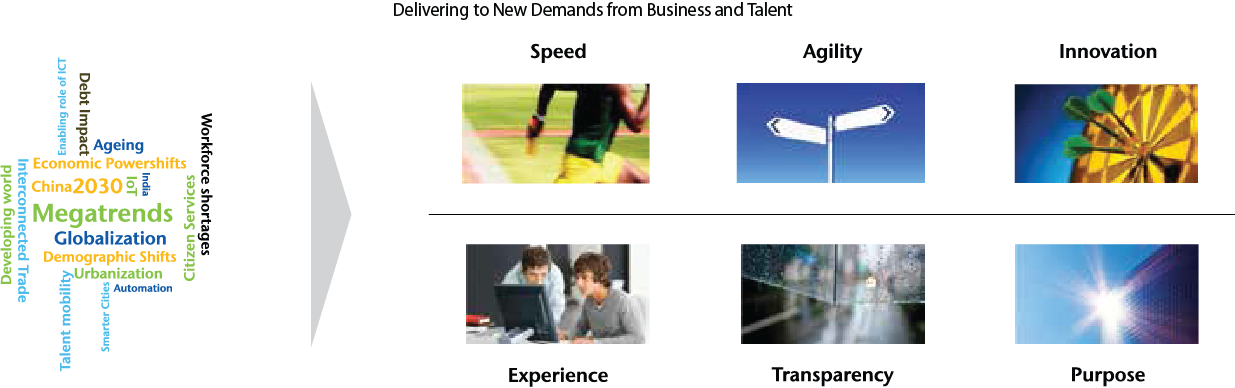
These three talent aspirations are not just pretty words
anymore. Consider this: the employer brand is naked;
platforms like Glassdoor give employees the freedom to
express opinions and share perspectives on their journey
within an organization. Social media is the leading channel
for recruitment, and gamification is the new way of
managing careers. Top talent will increasingly polarize
towards employers that offer a real, relevant and consistent
delivery on the aforementioned anchors.
Case in point, for the first time Aon's Global Risk
Management Survey that covers close to 1,400 risk
decision-makers (only about a percent being CHROs),
identified the failure to attract, and retain the right talent
as a Top 3 risk.4
Taking Stock
Never before has HR been faced with such a challenge
that brings with it the opportunity to be at the table
co-creating business results rather than just delivering
on them. The case of the refresh and reboot of HR is an
imminent reality. A refresh that changes perspectives
and relooks at what really matters to business and the
workforce; a reboot on the way talent management runs
and capabilities for the new world at work.
Successful HR organizations will live this "refresh and
reboot" reality by breaking away from the usual rut of
transactions and budget efficiencies.
"For a company of 30,000 employees, the HR budget will
average USD 65 million per year. Even a 10% improvement in
efficiency is more than USD 6 million annually - still important
to address, but far less impact. HOWEVER, for the same
organization a 10% increase in attracting and retaining pivotal
employees adds approximately USD 70-160 million to a
company's bottom line."
The power of co-creating and delivering business
outcomes will be critical for the function to create impact.
Our insights into this reimagined HR of the future led us
towards five key outcomes that successful HR organizations
will deliver upon.
-
Actualize culture: Culture plays the binding force
between the what and the how; as the anchor of the
values of an organization, it is the convergent point
of delivering on both the business demands and the
aspirations of the workforce. A strong culture results
not only in great business results but also helps one
become a talent magnet.
While we need not to talk about the business side success
of companies like Netflix and Google, their culture
manifestoes "freedom with responsibility' and "how Google
works' have over 11 and 2 million views on SlideShare
respectively. In fact, in an interview talking about the Netflix
culture note - It's one of the most-viewed SlideShares week
after week, has fetched more than 8 million views and has
been called by Facebook COO, Sheryl Sandberg, as one of
the most important documents to come out of Silicon Valley.
-
Future-proof the business through capability:
Consider these to statements made by revered business
leaders almost two decades apart; Jack Welch (1999)
"An organization's ability to learn, and translate that learning
into action rapidly, is the ultimate competitive advantage'
and John Chambers (2015) "Forty percent of businesses in
this room, unfortunately, will not exist in a meaningful way
in 10 years". Between these two, one can really notice
the growing importance of capability as an enabler of
an organization's strategy. The ability to take a longterm
view on 'here and now' capabilities needed for
businesses today and how they will shift in the future
|