Refresh and Reboot: Reimagining the Future of HR
gave rise to the "Tour of Duty' concept. If an employee
moved the needle on the business during the four years,
the company would help advance his/her career. Ideally,
this would entail another tour of duty at the company, but
it could also mean a position elsewhere.
"Learning and Careers' comes across as a disproportionate
focus across the Employee Value Propositions of Best
Employers, yet again underscoring the relevance of
delivering on employee aspirations and engagement.
Learning and Careers Take a Top Seat on the Employer Promise in APAC
Rankup to THREE which most closely reflect what you seek to offer to your employees
Percentage organizations with Employee Offers as Rank 1, 2 or 3
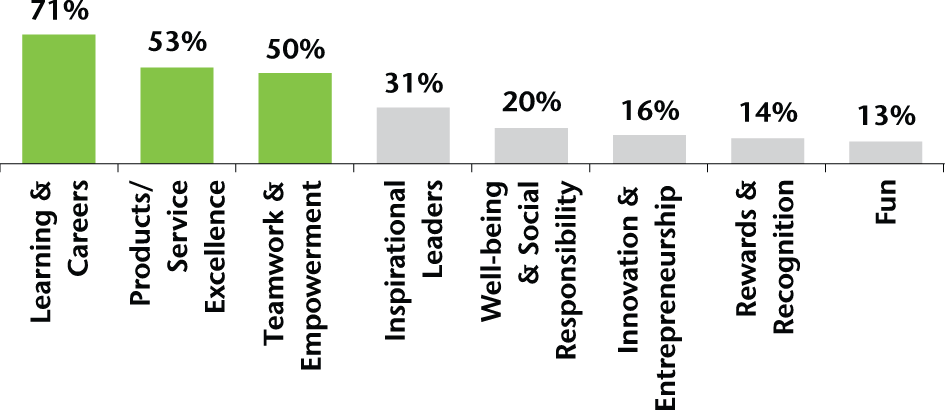
Source: Aon Hewitt
4. Enabling high performance:
High performance
organizations have clear accountability for strategic
goals, which are well-communicated and understood
by their employees. This robust alignment across the
employee hierarchy helps them not only to reward
and recognize their prime talent but also provides
challenging growth opportunities that meet the future
needs of the organization. As we reimagine the future,
there is room for creating a massive delta on
performance through social collaboration, individual
development and learning in the context of the
enterprise.
Much has been spoken and written about the new fad
of doing away with performance management; our take
is that it is a small cog in the wheel of enabling high
performance. There are different variations on this theme,
but essentially two flavors. One is Wishful Thinking and
the other is Surrender.
Wishful thinking: Get rid of employee ratings, but still pay
for performance and focus more on the employee-manager conversation. Wouldn't that be nice? Discarding ratings
simply moves differentiation underground, the result is
less transparency and trust, making employee-manager
discussions even more difficult than they already are.
Surrender: Stop all differentiation, spread rewards evenly
like butter and just let employees focus on doing their best.
This school of thought says it's just too difficult to
differentiate employees, and merit increase budgets are
too small to matter, so why bother? The only thing that this
"strategy" gets right is the recognition that differentiation
and paying for performance go hand-in-hand, so its
solution is to simply get rid of both.
Performance management that actually works and
delivers on its promise can help you win the war for talent.
But wishful thinking and surrender are losing strategies.
So is jumping into a new fad without thoughtfully
connecting it to your talent strategy. Managing,
differentiating and rewarding for performance is still the
winning formula. But it has to be executed well. Rethink
your performance management process from top to
bottom - stop complicating things and start simplifying.
Performance needs clarity of purpose, the courage to
follow through, investments in development, the elegance
and user-friendliness of simplicity, and the basics of
engaged managers.
5.
Influencing change: All the efforts and outcomes we
spoke of will come to fruition if there is the ability to
influence change; there are elements that HR can
drive, but there are also those where HR will play the
role of a facilitator. The journey to driving these
outcomes needs willful collaboration and not power
plays, it needs shifting mindsets and not dictates, it
needs storytelling and not numbers. Change and
influence on the business and employees will define
success.
In a recent study concluded by Aon spanning close to
50 CHROs of leading global firms, the ability to drive and
influence change came up on the Top 3 competencies critical to succeed in the role of a CHRO.
Here are Some Thought Starters as You
Look at Your "Refresh and Reboot" Journey
-
Looking at all these triggers, a simple way would be to
rate your HR organizations on a scale of 1 to 6 (1 being
not there at all and 6 being spot on) across the current
and desired state
-
We suggest you involve some external inputs
(business, employees, etc.) and do this exercise
|