Pharmaceutical Industry: Finger on the Pulse
-
Shift towards specialty pharma/innovator drugs: While
India is primarily a branded generics market (90%),
it is imperative that it enters the innovator/specialty
pharma space. With the increasing margin pressures
that the generics business has been lately witnessing,
it is important that the players focus on niche
therapeutic categories like oncology, dermatology,
diabetes amongst others and have at least a couple of
innovator drugs in their portfolio
-
Consolidation and mega mergers: In the last half a
decade, there has been a distinct evolution in the
various strategic alliances that have happened. While
earlier alliances were restricted to product/geographic
expansion or vertical integration, there have been
numerous pipeline, licensing and co-marketing
deals that the industry has witnessed. The recently
announced Sun Ranbaxy deal could potentially open
the doors to some mega mergers in the industry
leading to a scenario wherein only the "big fish"
dominate the space
-
Compliance and regulatory framework: Regulatory
framework will continue to tighten its noose - effective
compliance will form part of the core strategy for the
pharma players, going forward. With the increasing
stringency of the Food and Drug Administration
(FDA) around Good Manufacturing Practices (GMP),
there would be a considerable focus around state-ofthe-
art high quality manufacturing facilities. While
there can be limited strategic responses to pricerelated
regulations (Drug Price Control Order), cost
discipline, i.e. "cutting the flab" will be a key focus area
Despite shakeups here and there, the pharma industry
has always been a blue eyed boy of the investors. This
has been adequately reflected by the salary and rewards
trends in the industry.
Salary Increases Mirror the Growth Story
The salary increases for the pharmaceutical industry
have been higher than that of the overall industry for a
decade which is a result of the higher growth that the
industry has seen when compared to the overall GDP
growth rate. For the period 2009-13, the GDP growth
rate has been 6% while the pharma industry has grown
by 20% (domestic growth at 18% and exports have
grown by 26%). This possibly explains why pharma has
sustained the spot of being the industry with the highest
salary increase. This is compounded by the fact that traditionally it has been associated with lower base pay,
and the recent years have seen a catch up momentum.
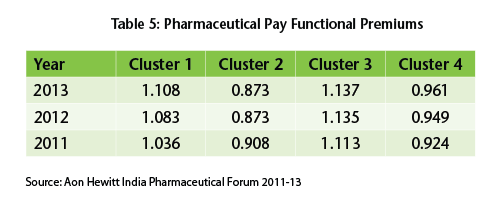 The pharma industry has witnessed the highest net
addition of jobs across the years to support the consistent
growth rate - most of these additions have been in sales
and as a result, the junior management has seen the
highest salary increases across all levels of management.
The pharma industry has witnessed the highest net
addition of jobs across the years to support the consistent
growth rate - most of these additions have been in sales
and as a result, the junior management has seen the
highest salary increases across all levels of management.
Salary Trends for Indian vs. Multinationals: In Line with their Strategies
The Indian organizations which are on a massive global
expansion spree are observed to be heavily investing
in getting high quality talent for their top management
and lead the foreign players by at least more than
10% in terms of Total Cost to Company (TCC). This also
showcases their efforts in getting leaders who can lead
the transformational changes the Indian players are going through.
The foreign multinationals were observed to pay
higher at the junior and middle management cadre with
a 25-30% premium on both Total Cost to Company
and Total Fixed Pay over Indian companies. But over the
years, with increased war for talent and in their efforts
to remain market-competent, Indian companies with
a sustainable higher growth rate than multinationals
have been making conscious efforts to bridge this gap
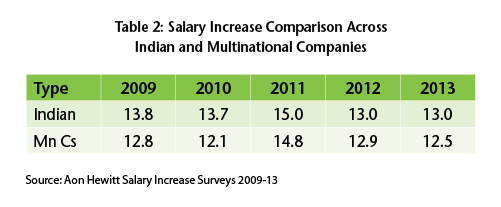
which has translated into higher overall salary increases
for Indian companies vis-à-vis foreign multinationals.
|
|