Pharmaceutical Industry: Finger on the Pulse
aggressive at junior management (field sales level), the
multinational and Indian companies converge across all
other management levels.
B) Pronounced Functional Premiums and
Pay Strategy
The industry has seen a more pronounced functional pay
strategy evolve. The functions can be clustered into four
types mentioned below n the basis of similar talent and
work patterns.
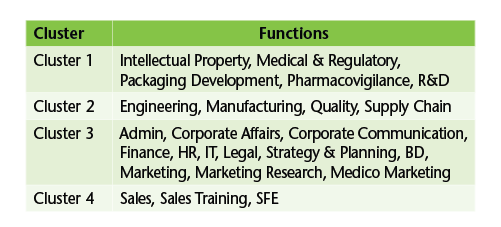 These functional clusters have seen a clear pay
differentiation strategy evolve. As tabled below -
the transition from 2011 to 2013 shows a sharper
differentiation across functional clusters. Cluster 3 and 1
emerge as the functions with premium - Cluster 3 which
has all the corporate functions is high on premium
as most pharma companies are increasingly looking
at other sectors like FMCG, banks, telecom, IT to get
talent for support positions; Cluster 1 which has all
the R&D and related functions has seen a major talent
war within the sector as R&D budgets for most Indian
companies have seen a year-on-year growth of 20-40%.
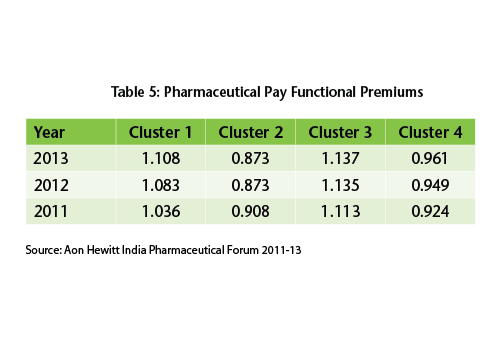
These functional clusters have seen a clear pay
differentiation strategy evolve. As tabled below -
the transition from 2011 to 2013 shows a sharper
differentiation across functional clusters. Cluster 3 and 1
emerge as the functions with premium - Cluster 3 which
has all the corporate functions is high on premium
as most pharma companies are increasingly looking
at other sectors like FMCG, banks, telecom, IT to get
talent for support positions; Cluster 1 which has all
the R&D and related functions has seen a major talent
war within the sector as R&D budgets for most Indian
companies have seen a year-on-year growth of 20-40%.
Cluster 2 - manufacturing and associated functions
are very region-specific and thereby the compensation is
usually driven by the region and its endemic talent pool.
This has historically been a function with the highest
discount with respect to compensation and continues
to be so. Cluster 4, the sales force makes up for the
majority of the workforce, especially at the junior levels,
and this cluster has been observed to be the one nearest
to the level median.
 C) Client Considerations
Aon Hewitt interviewed some of the notable C&B
professionals of pharmaceutical companies, to understand
their thoughts around rewards and the overall business.
We have summarized some of the extracts, based on
our discussion:
-
Some of the organizations have adopted a "wait and
watch approach", i.e. while they are optimistic about
the future prospects, they would exercise some bit of
caution given the larger economic sentiment. They
are aligning their existing strategies to cater to the
immense growth opportunities, while they are
keeping an eye on costs as well
-
"Do more with less" is the key message across the
board. Having said that, priorities continue to be
investment in the form of rewards initiatives
(compensation benchmarking, benefits, internal pay
ranges, etc.) such that rewards programs keep fueling
business transformation
-
More transparency and manager involvement: While
earlier all strategic discussions were limited to
boardrooms, there has been an increasing involvement
of managers in the decision-making process. This has
led to increased sense of ownership and accountability
in the minds of the employees with respect to
rewards programs
Buoyed by strong growth drivers, the Indian pharma
industry is all set for an exciting journey going forward.
Now with a stable government at the helm, its growth
story seems more sound and sustainable.
|