
Part 1 - Your Duty Explained
At its most basic, consent is about gaining a patient’s agreement to treatment.
How clinicians seek and obtain that agreement is a much more complex matter and one the courts have shaped through case law. With potentially significant consequences for both parties if this process falls down, clinicians need to be cognisant of the duties upon them in this area.
Current Legal Position
“The starting point for informed consent is the Supreme Court’s decision in the case of Montgomery v. Lanarkshire Health Board [2015] 1. Montgomery has been widely analysed as a significant shift away from an approach described as ‘medical paternalism’ – that is to say, the attitude of “trust me, I’m a doctor” – to an approach that is much more focused on patient autonomy.” Stuart Keyden, Partner, DAC Beachcroft.
Montgomery v. Lanarkshire Health Board (2015) - Supreme Court
Question: Was a doctor negligent in not informing a pregnant diabetic woman that there was a 9-10% risk of shoulder dystocia during vaginal delivery? Answer: YES
Below are extracts from the judgment in Montgomery, where the focus on patient autonomy comes to the fore:
- “One development which is particularly significant…is that patients are now widely regarded as persons holding rights, rather than as the passive recipients of the care of the medical profession.”
- “It would…be a mistake to view patients as uninformed, incapable of understanding medical matters, or wholly dependent upon a flow of information from doctors.”
- “The doctor’s advisory role cannot be regarded as solely an exercise of medical skill without leaving out of account the patient’s entitlement to decide on the risks to her health which she is willing to run (a decision which may be influenced by non-medical considerations).”
Against this backdrop, the Supreme Court introduced a new duty on doctors when it comes to the consenting process, with that duty being anchored to a test of “materiality”.
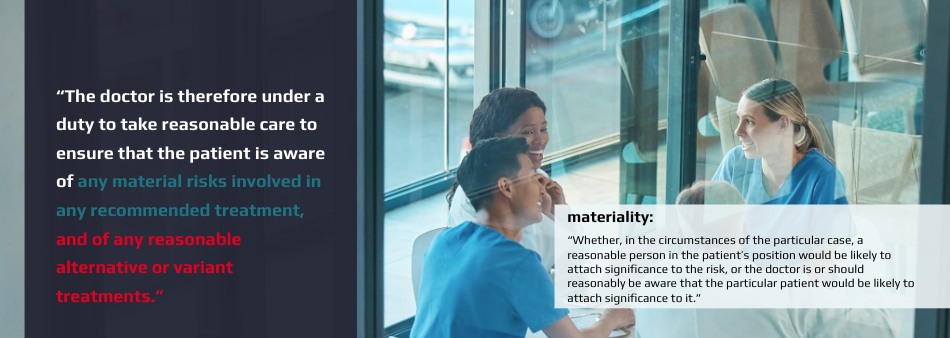
The Montgomery Test
So, what is the Montgomery test that should now be applied when warning patients of material risks? The test is twofold – parts a and b below apply: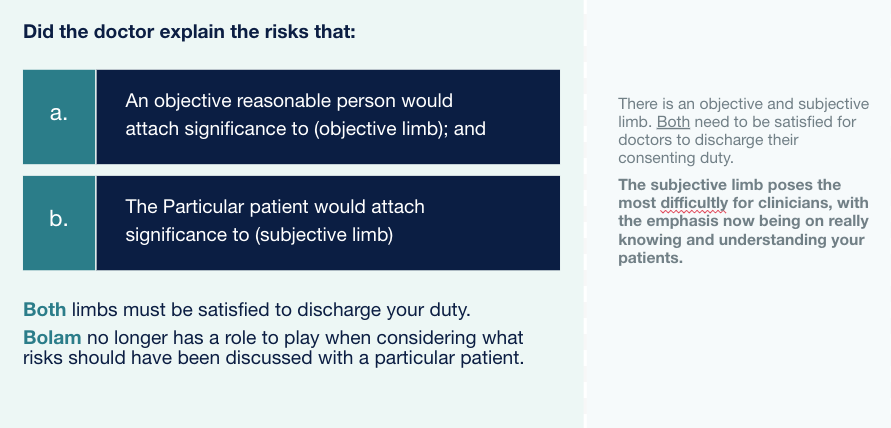
Does The Bolam Test Still Apply?
“The Bolam test, which is whether the approach adopted would be supported by a reasonable body of medical professionals, now plays no part in the question of what risks should be discussed with a particular patient. But it is not correct to say that the Bolam test has absolutely nothing to do with consent anymore; we know from the Montgomery duty itself that clinicians are also under a duty to make the patient aware of any reasonable alternative treatments. The Supreme Court have more recently confirmed, in the case of McCulloch v. Forth Valley Health Board [2023] 2 , that the Bolam test still applies to the question of whether a patient should have been advised of reasonable alternative treatments.” Stuart Keyden, Partner, DAC Beachcroft.
In the McCulloch case, the question was whether a doctor was negligent in not discussing non-steroidal anti inflammatories for a history of chest pain. The clinician’s judgment call made in McCulloch was that anti inflammatories were not a reasonable option, on the basis that the patient was not in pain at that particular time. Unfortunately, the patient in this case, who it turned out had pericarditis, was discharged and then sadly had a heart attack and died.
The Supreme Court held that the doctor here was not negligent and, in doing so, confirmed that the Bolam Test still applies to the question of whether a patient should have been advised of reasonable alternative treatments.
Bolam says:
The Bolam Test:
“[A medical professional] is not guilty of negligence if he has acted in accordance with a practice accepted as proper by a responsible body of medical men skilled in that particular art…Putting it the other way round, a man is not negligent, if he is acting in accordance with such a practice, merely because there is a body of opinion who would take a contrary view.”
When a doctor decides that only some of the possible treatment options are reasonable and that view is supported by a reasonable body of medical opinion, the doctor is not negligent.
Apologies for the outdated gender stereotyping - this is a direct quote from 1957.
“Essentially, when a doctor decides that only some of the possible treatment options are reasonable, and that view is supported by a reasonable body of medical opinion, then that doctor is not negligent. Following that through to its logical conclusion, doctors are not necessarily required to disclose and discuss each and every single possible treatment option.” Stuart Keyden, Partner, DAC Beachcroft.
This is echoed in this direct quote from the Supreme Court in the McCulloch judgment:
“It is important to stress that it is not being suggested that the doctor can simply inform the patient about the treatment option or options that the doctor himself or herself prefers. Rather, the doctor’s duty of care, in line with Montgomery, is to inform the patient of all reasonable treatment options applying the professional practice test.”
Clinicians therefore can reasonably apply their knowledge and professional judgement when selecting which treatment options to present to a patient. However, they must present the risks associated with each of the options that both a reasonable person and that specific patient would consider to be material, i.e., attach significance to.
For more information contact [email protected]
Sources:
1 The Supreme Court Case Details - Montgomery (Appellant) v Lanarkshire Health Board (Respondent) (Scotland) - www.supremecourt.uk/cases/uksc-2013-0136.html
2 The Supreme Court Case Details - McCulloch and others (Appellants) v Forth Valley Health Board (Respondent) (Scotland) - www.supremecourt.uk/cases/uksc-2021-0149.html
Whilst care has been taken in the production of this article and the information contained within it has been obtained from sources that Aon UK Limited believes to be reliable, Aon UK Limited does not warrant, represent or guarantee the accuracy, adequacy, completeness or fitness for any purpose of the article or any part of it and can accept no liability for any loss incurred in any way whatsoever by any person who may rely on it. In any case any recipient shall be entirely responsible for the use to which it puts this article. This article has been compiled using information available to us up to 10/06/2024.