
Part 4 - Children & Young People
When consenting children for medical procedures, it is important to be familiar with how to assess their capacity to provide informed consent, depending on their age. Care must be taken to ensure that consent to the child’s treatment comes from the correct source.
We explore this topic with Benjamin Newall, Senior Associate, from DAC Beachcroft below.
When deciding whether a child under the age of 16 has capacity to consent to their treatment, you must consider the following - Gillick Competence under common law, the Children Acts 1989 and 2004 and the role of Parental Responsibility, and the High Court. This is also covered by Chapter 19 of the Mental Health Act 1983 (Code of Practice 2015, 19.35).
Under 16s and Gillick Competence
“A young person under 16 may have the capacity to consent, depending on their maturity and ability to understand what is involved” (GMC Guidance, 0–18 years: guidance for all doctors content) 1.
An assessment of whether a child under the age of 16 is able to consent to their treatment and is Gillick competent should involve you considering:
- Their ability to understand and weigh up options.
- Whether they are able to understand the nature, purpose and possible consequences of investigations or treatments proposed, as well as the consequences of not having treatment.
- Their level of maturity and understanding on an individual basis and with regard to the complexity and importance of the decision to be made.
- That the child’s capacity to consent can also be affected by their physical and emotional development and by changes in their health and treatment.
The Code of Practice 2015, 19.36, provides the following guidance:
“When considering whether a child has the competence to decide on the proposed intervention, practitioners may find it helpful to consider the following questions.
- Does the child understand the information that is relevant to the decision that needs to be made?
- Can the child hold the information in their mind long enough so that they can use it to make the decision?
- Is the child able to weigh up that information and use it to arrive at a decision?
- Is the child able to communicate their decision (by talking, using sign language or any other means)?”
- Has the child or young person been given the relevant information in an appropriate manner such as age- appropriate language?
- Have all practicable steps been taken to help the child or young person make the decision? The kind of support needed to achieve this will vary, examples include:
- Taking steps to help the child / young person feel at ease
- Ensuring that those with Parental Responsibility are available to support the child (if that is what the child / young person would like)
- Giving the child / young person time to absorb information at their own pace
- Considering whether the child / young person has any specific communication needs (and if so, adapting accordingly).
- Can the child / young person decide whether to consent, or not to consent, to the proposed intervention? Are they Gillick Competent?
- The father if:
-
He was married to the mother:
- England and Wales - when the child was born
- Scotland - before or at any point after conception
- Northern Ireland – when the child was born or after if he lives in NI at the time of the marriage.
- He was listed on the birth certificate after 1/12/03 in England and Wales, 4/5/06 in Scotland and 15/4/02 in Northern Ireland or
- He has a Parental Responsibility agreement with the mother or a Parental Responsibility order from the court (England and Wales)
- Same sex partners
- Civil partnership at the time of the fertility treatment - both have Parental Responsibility
- Non-civil partners – the second parent if:
- They apply for parental responsibility if a Parental Agreement was made or
- They become a civil partner of the other parent and make a responsibility agreement / jointly register the birth
- The adoptive parents
- Anyone with a special guardianship order or child arrangements order e.g., grandparents, stepparents etc. This is a legal document that must be obtained through the courts
- The local Health and Social Care (HSC) Trust where the court makes a care order – in these cases Parental Responsibility is usually shared with parents. Please note, foster parents do not have Parental Responsibility.
Where a child is deemed to be Gillick Competent, they have a right to consent (or not) to treatment and a clinician should rely on this over the instructions of the person with Parental Responsibility.
Consent Process
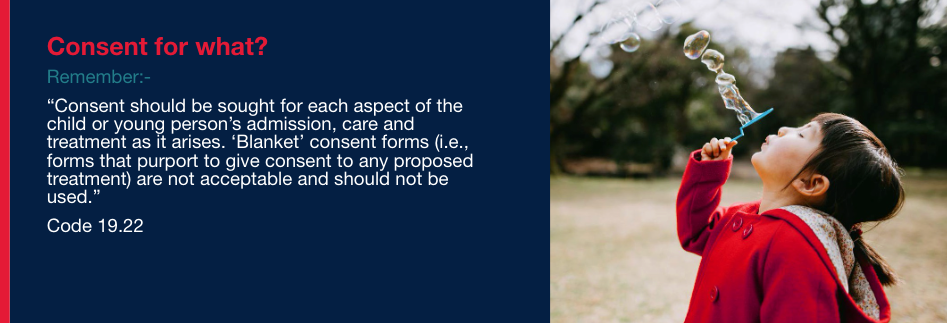
“Consent should be sought for each aspect of the child or young person’s admission, care and treatment as it arises. ‘Blanket’ consent forms (i.e. forms that purport to give consent to any proposed treatment) are not acceptable and should not be used.” (Code of Practice 2015, 19.22)
“Consultants [and clinicians] should be able to evidence that consent has been sought for each aspect of the child or young person’s admission, care and treatment as it arises and that the consent is specific about the treatment.” Benjamin Newall, Senior Associate, DAC Beachcroft.
There is further guidance for consenting children under the age of 16. Clinicians should consider three questions:
Parental Responsibility
Parental Responsibility is always held by mothers from birth, unless removed by the courts. However, it can also be held by:
NB divorce does not remove Parental Responsibility. or
Establishing who holds Parental Responsibility can be a challenge and may require a delicate conversation. However, being confident the person giving or withholding consent on your patient’s behalf is vital to demonstrating that you have the authority to proceed with the agreed treatment.
“There may be situations where the person with Parental Responsibility says “no” to the planned treatment. However, the valid consent of a child or young person (deemed to be Gillick competent) will be sufficient authority for their admission to hospital and/or treatment for mental disorder. Additional consent will not be required.
It is good practice, however, to involve the child or young person’s parents (and others involved in their care) in the decision-making process if the patient consents to information about their care and treatment being shared (reference code 19.21).
In cases involving disputes around consent for the treatment of a child, we have seen a gradual shift in the approach by the courts. This is since the Human Rights Act 1998 (reference Code 19.39 2 where more weight was placed on the child’s decision.”Benjamin Newall, Senior Associate, DAC Beachcroft.
Overall, the patient experience is likely to be more positive, and supportive, if you can involve the parents in the decision-making journey.
The Competent and Non-competent Child (under 16s)
Where a child is competent to make the decision at hand, whether providing consent or otherwise, clinicians should not rely upon consent provided by someone with Parental Responsibility.
Where a child is not deemed competent to make the decision at hand, clinicians can then look to Parental Responsibility.
Consent for 16-17 years olds
“A young person can give consent and generally the Mental Capacity Act will apply when dealing with a child of 16 or 17. Sections 2 and 3 of the Act provide details of how to assess capacity.
However, Parental Responsibility will apply when the young person is incapable of giving consent. In these cases, the patient will be assessed under the Mental Capacity Act and treatments may be given under Best Interest guidance”Benjamin Newall, Senior Associate, DAC Beachcroft.
The GMC has specific guidance for all doctors treating patients from 0-18 years (0-18 years - professional standards - GMC (gmc-uk.org)). There are nuances to their treatment that need to be considered. Consent is one of these areas and, should you treat young people, it is important to be familiar with the relevant law and ethics.
For more information contact [email protected]
Sources:
2 - https://www.legislation.gov.uk/ukpga/1998/42/contents
Whilst care has been taken in the production of this article and the information contained within it has been obtained from sources that Aon UK Limited believes to be reliable, Aon UK Limited does not warrant, represent or guarantee the accuracy, adequacy, completeness or fitness for any purpose of the article or any part of it and can accept no liability for any loss incurred in any way whatsoever by any person who may rely on it. In any case any recipient shall be entirely responsible for the use to which it puts this article. This article has been compiled using information available to us up to 10/06/2024.