
Part 6 - Legal Insight - Issues with Consent Processes
It is essential to be familiar with the legal framework and up-to-date on the law on consent. If you are not confident in this area, then please read Aon’s Informed Consent Insight Series – Part 1: Your Duty Explained and Part 2 – Lessons Learned from Post Montgomery Cases. Remember, the law on consent continues to evolve which impacts the landscape within which clinicians work and consent is obtained. The introduction of AI technology in medical treatment is also gathering momentum and clinicians should be alert to the wider consent issues this raises when discussing such treatments or procedures with patients.
“Clinicians are often concerned that they only have a short period of time (sometimes just 10 minutes) to discuss a proposed treatment or procedure with a patient and to start the consent ‘process’”. Benjamin Newall, Senior Associate from DAC Beachcroft, emphasises the need for there to be a clearly documented consent process and suggests consideration should be given to the following factors to ensure you have robust consent practices in place:
Records
-
Is there a documented process?
“When [lawyers] investigate a claim for alleged negligence, they need to see that there is a documented process in the records showing the consent process” Benjamin Newall, Senior Associate, DAC Beachcroft.
It is important to review the records to check for previous entries relating to the consent process for a treatment or procedure. This ensures that you do not make unexpected changes to the patient’s treatment plan that could result in treatment being provided against the patient’s wishes.
-
Is a signed consent form enough?
Even where there is a consent form listing the main risk/s signed by the patient, “from a lawyer’s point of view, this may not be sufficient. What we need to be able to evidence is that there has been a process where the patient has been given the opportunity to go away and think about their treatment options, to think about the risks involved with those options and has come back and made their decision. Understandably, this presents a difficulty for clinicians in the often limited time available” Benjamin Newall, Senior Associate, DAC Beachcroft.
-
Is verbal consent acceptable?
Yes - verbal consent is acceptable. However, it must be documented and recorded that this was the way the patient provided their consent. It is also important that the process leading up to the verbal consent being given has been documented.
Timing
Benjamin Newall, Senior Associate at DAC Beachcroft, says the signing of a consent form immediately before surgery where only limited, or possibly no other, discussions have taken place should be avoided. It is important that there is a consent process which can be evidenced where the patient has been given both the information and the time to consider their options.
“The signing of a consent form prior to a procedure really needs to be the final sign off by the patient who is clear about their decision.”
Information given
-
Is there a leaflet?
Benjamin Newall says there are often cases where practitioners say that the patient would have been given a leaflet- containing all the details of the treatment, risks and benefits – but the patient says they have no recollection of this. In these instances, the lawyers look to the records or the treatment provider to find a copy of the relevant leaflet. Cases are more problematic to defend where a leaflet for a procedure or treatment cannot be found or does not exist.
Giving a patient a resource they can take away, consider, and use to answer questions is useful but, like all aspects of the consent process, the provision of a leaflet to a patient should be documented. Ideally, a copy of the version of the leaflet provided should also be included in the patient’s medical records.
Options
-
Is the patient fully informed?
The patient needs to be told about the reasonable risks and alternatives and should be fully aware of what they are consenting to.
Not all alternative treatments need to be disclosed but there should be a discussion with the patient to ensure the most appropriate treatment options are given to them to consider.
Things to Remember When Consenting
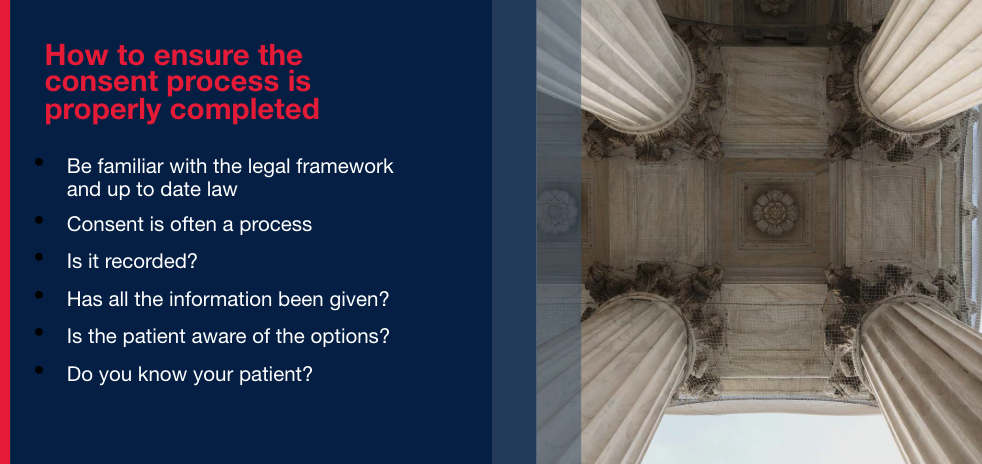
Be familiar with the legal frame Be familiar with the Law
The law on consent is evolving and clinicians are encouraged to keep themselves up to date. For example, before the Supreme Court decision in McCulloch v Forth Valley Health Board1 [2023], doctors understood that they needed to cover more information with a patient than has now been clarified for them to do so when obtaining consent.
Consent is a Process
Whilst a patient may agree to the proposed treatment at an initial consultation, it is important they are allowed time to go away and reflect on their decision. They will likely talk to family, friends, possibly someone who may have had a similar procedure, or do their own research. All of these examples will shape their thinking - and their decision could change between the consultation and the date for the proposed treatment/procedure.
There should be scope within the process to review consent at appropriate intervals to ensure there are no changes to the patient’s wishes. The patient should not find themselves in a position where they are signing a consent form when they still have questions or are unsure about whether they actually want to go ahead with the procedure.
Record the Process
“We cannot emphasise more the need for a consent process, and any assessment of capacity, to be documented clearly in the records. That will be the evidence that is most relied upon. It is very difficult to defend a consent claim where clinicians say they completed a consent process with a patient, but they did not document it” says Benjamin Newall, Senior Associate, DAC Beachcroft.
The documentation should include the full process - including consent being given - and possibly being withdrawn.
Clinicians should be able to look back at the patient’s records and understand the decisions that were taken and the discussions that may have already taken place with other practitioners.
Provide Information – Including Options
As much information as reasonably possible should be given to a patient regarding the recommended treatment options, some of which may not be available with the treatment provider.
More detailed information on this can be found in Aon’s Informed Consent Insight Series – Part 1: Your Duty Explained and Part 2: Lessons Learned from Post Montgomery Cases.
Know Your Patient
“This is probably the most important part of the consent process. Do you actually know your patient well enough to understand what might be the preferred option for them? Exploring what they may do as a job, for example, may provide a valuable insight. As an example, foot treatment options for a professional footballer may be different to those for an office worker who does not play sport” explains Benjamin Newall, Senior Associate, DAC Beachcroft.
Having insight into the patient and what is important to them is a key element on the Montgomery Test (see Aon Informed Consent Insights Series Part 1: Your Duty Explained to learn more about the test).
But it is also important to put this into some context… Consent usually forms part of, rather the entire, complaint where a claim is brought for alleged medical negligence. Should you receive a negligence claim then you may wish to consider the following tips from Benjamin Newall, Senior Associate, DAC Beachcroft.
Tips when Responding to Claims
-
Early identification of issues
“This applies where anything goes wrong. Rather than let matters sit there unaddressed, it is much better at an early stage if these issues can be identified and brought to the fore. If we can avoid a complaint being made, then we may well avoid a claim being brought.” Benjamin Newall, Senior Associate, DAC Beachcroft.
Clinicians are best placed to identify and report potential complaints promptly.
-
Understand the legal issues
It is useful for clinicians to understand what constitutes a breach of duty and what is meant by causation from a legal point of view.
Benjamin Newall (DAC Beachcroft) says sometimes the potential for a claim can be overlooked. He has seen “examples where clinicians have said the patient may have been given antibiotics a few days late but that they cannot see the outcome would have been any different. The difficulty with this is that, whilst perhaps the significant injury the patient is claiming for might not be the result of the specific delay in administering antibiotics, strictly speaking, in law, if the patient experienced a few days of additional pain and suffering because they did not get their antibiotics in time, then they could have a valid claim for that additional period of pain and suffering.”
-
Early engagement
Clinicians are very busy, and it is understandable that they may not prioritise an email/letter from their legal or risk department or a solicitor asking for comments on a claim over the delivery of patient care.
“Engaging at an early stage… it is best to deal with it straight away and respond so that time does not go by and the evidence becomes more vague as memories fade” Benjamin Newall, DAC Beachcroft.
Where there are delays in resolving claims, not only will the legal costs incurred increase, but patients and practitioners involved in the case will have a more protracted and stressful experience.
-
Be open
“Don’t be afraid to say if there is a potential issue. This doesn’t just apply if there is a claim but also during your day-to-day work. If there is a problem – or something that looks like it could become a problem – flag it up and try to deal with it as best you can with those around you so that it can be avoided for the future” Benjamin Newall, Senior Associate, DAC Beachcroft.
-
Settlement
Clinicians often find it frustrating to be asked by their legal advisors to consider settling a case – particularly when they consider no negligence has occurred.
“There is a financial aspect to this… going to trial is extremely expensive but it should not just be about the cost…often those supporting [the clinician] will not recommend a settlement purely on the basis of the cost of going to trial.
However, if there are any risks involved in defending a claim or aspects of a claim, then going to trial is an extremely risky business... clinician(s) would have to attend court to give evidence and this can place a huge amount of stress on them. Clinicians also need to think about the outcome of a trial, for example, If an adverse decision is made regarding the aspect of care they provided. Claims can also take up to three or more years to reach a trial, so this is a long time for a clinician to have to be involved in the background.
Settlement is not saying ‘we admit liability’. What it is saying is that we acknowledge there are risks. Similarly, the patient – known as the claimant – must also recognise that they have risks of losing at a trial too. This means the parties can negotiate with a view to reaching a discounted settlement to avoid trial. In fact, the courts encourage parties to settle.” Benjamin Newall, Senior Associate, DAC Beachcroft.
With no guarantee of success, settlement has many benefits. Further, a good offer which is not accepted by the claimant could result in some legal/court costs being recouped by the defendant.
-
Lessons learned
Whilst clinicians may instinctively wish to put any claims behind them, it is important that time is taken, throughout and at the conclusion of the claim, to discuss what can be learned and how to avoid a similar situation in the future. Sometimes, there is a request to provide details of how lessons have been learned with a view to future claims being avoided.
For more information contact [email protected]
Sources:
1 The Supreme Court Case Details - McCulloch and others (Appellants) v Forth Valley Health Board (Respondent) (Scotland) - www.supremecourt.uk/cases/uksc-2021-0149.html
Whilst care has been taken in the production of this article and the information contained within it has been obtained from sources that Aon UK Limited believes to be reliable, Aon UK Limited does not warrant, represent or guarantee the accuracy, adequacy, completeness or fitness for any purpose of the article or any part of it and can accept no liability for any loss incurred in any way whatsoever by any person who may rely on it. In any case any recipient shall be entirely responsible for the use to which it puts this article. This article has been compiled using information available to us up to 10/06/2024.