Locational Differentiation in the IT-BPM Industry - Myth or Reality?
We do see some of the larger IT
services organizations adopting a
more localized hiring strategy for the
lower end development support jobs
by hiring non-engineering graduates
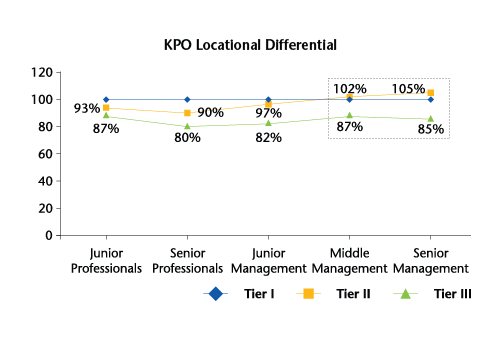
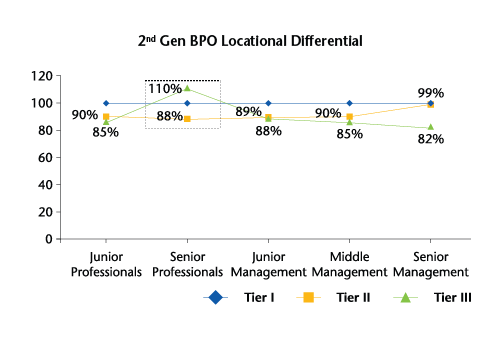
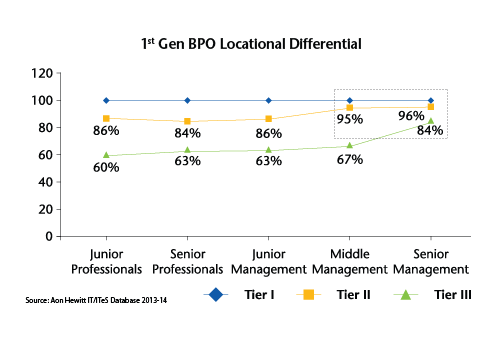
India since the beginning of the outsourcing trend seem
to have a far higher locational cost difference as compared
to 2nd Gen BPO jobs (banking back office, finance &
accounting, etc.) and KPO jobs (research & analytics,
modeling, etc.). In fact, for specific roles in KPOs and 2nd
Gen BPOs, we see the per FTE cost to be in line and in
some cases higher than the per FTE costs observed for
these processes in Tier I cities. This is predominantly due to
demand-supply imbalances for these niche skills in Tier II
and Tier III cities. Another factor that is contributing
to this trend is the fact that a lot of organizations have
transplanted employees at the mid and senior levels
from Tier I cities to seed the new locations and provide
management guidance and therefore, their compensation
levels were more in line with Tier I cities rather than Tier II
and Tier III cities.
In the IT services space, we see clear cost arbitrage in
lower end development and technology support jobs such
as testing and infrastructure maintenance as opposed to
the trends that are seen in the higher end application/
software development. The cost advantage that is seen at
the lower levels for development support jobs disappears
at the management levels. This, in all likelihood, is a factor
of the fact that IT services organizations have a location
strategy that is still maturing and the management
staff has been placed in these cities inorganically from
Tier I cities rather than growing them internally in Tier
II and Tier III cities. Aon Hewitt predicts that this trend
will normalize over the next few years given that the
individual contributors in Tier II/Tier III cities would have
matured to take on management roles by then. The other
interesting trend that we see in IT services is the fact that
there is not a significant cost arbitrage between Tier II
and Tier III cities even for development support jobs. This
again, we believe, is due to the fact that as compared to
Third-Party BPOs, IT services firms have not aggressively
pursued a Tier III city strategy.
The most important reason that comes across for this
trend, i.e. the IT services having smaller differences in
the per FTE cost as compared to Third-Party BPOs, is the
entry level hiring strategy and talent mobility. Third-
Party BPOs hire their entry level talent locally from the
talent pool available around the Tier II or Tier III city and
more often than not, the employee will be based out of
that Tier II/III city for a large portion of his/her career.
The talent pools hired in Tier I/II and III cities do not
get trained together or work together. IT services firms
hire talent nationally, train them together and deploy
them across Tier I/II/III cities based on project demand.
Such a central hiring strategy along with higher talent
mobility in IT services prevents them from having
|