Locational Differentiation in the IT-BPM Industry - Myth or Reality?
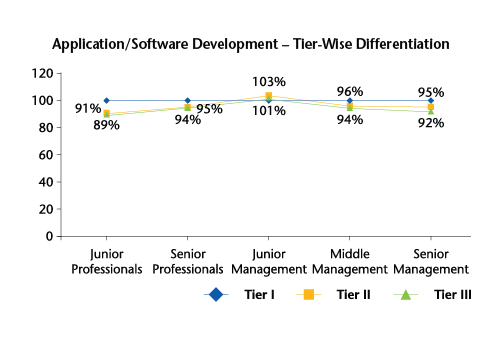
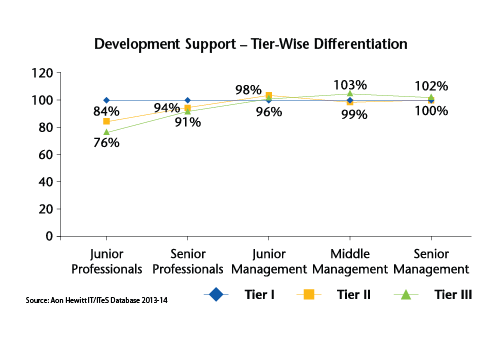
significant differentiation in compensation based on the
city in which the employee would be based out of.
However, we do see some of the larger IT services
organizations adopting a more localized hiring strategy
for the lower end development support jobs by hiring
non-engineering graduates from local catchment areas
who would come in at significantly lower cost. This
trend as of now is not broad-based; however, given the
pressures on cost and optimization, we predict that this
would be one of the key trends to look out for over the
coming years.
Fortune at the bottom of the pyramid: Based on the
analysis done by Aon Hewitt's Workforce Analytical Tool,
it can be deduced that not only are the less complex
jobs moving to Tier II and Tier III cities, but the nature of
the jobs that are moving to Tier II and Tier III cities are
based on the capabilities being created in those cities.
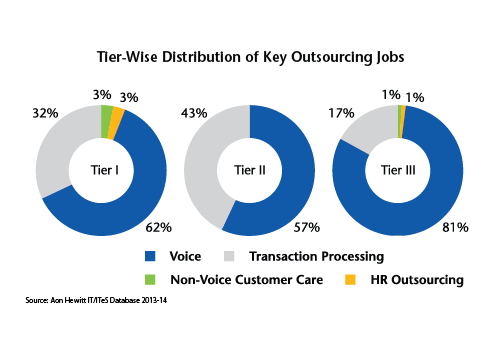
Taking a deep dive into the 1st Gen BPO jobs across the
locations, we see a prevalence of voice jobs in Tier III
cities and transaction processing jobs in Tier II cities. We
see a clear value chain in the jobs moving from Tier I to
Tier II and then to Tier III cities based on process maturity
and levels of industrialization.
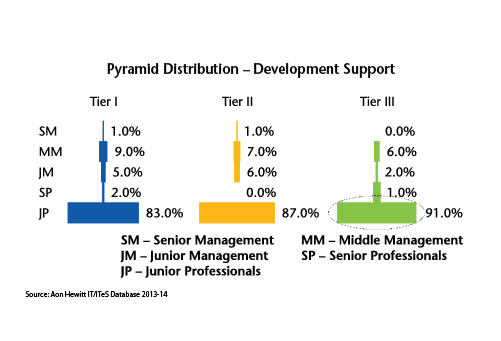
Not only do we see a clear trend of the types of jobs that
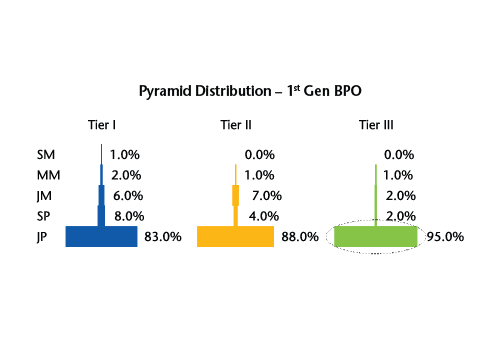
are moving from Tier I to Tier II and Tier III cities, we also see
a difference in the complexity of jobs that are moving. The
headcount pyramids we see in Tier II and Tier III cities are
comparatively more bottom-heavy compared to Tier I cities
signifying that even for the job families that are moving
from Tier I to Tier II and then to Tier III cities, the complexity
of the job keeps on reducing either through greater process
stability or through rapid industrialization. Technology
and outsourcing organizations will, over a period of time,
evolve their version of BOT (Build - Operate - Transfer) to
ensure that their locational strategy is successful from a
cost containment perspective.
And... it gets better: Traditional rewards philosophy
states that ceteris paribus, as you reduce the level of
compensation of individuals, there is usually an increase
|