Fortune Favors the Fittest
The Industry Divide
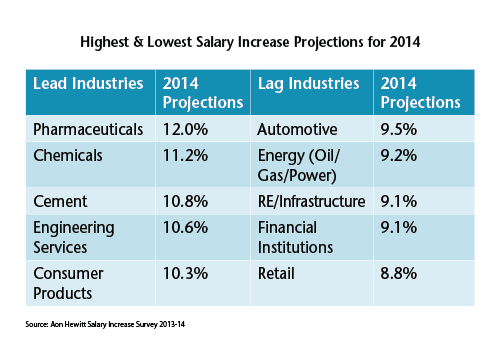
Sectors largely reliant on domestic economy such as
pharmaceuticals, chemicals, engineering services and
consumer goods, are projecting the highest salary increases,
typically above 10% for 2013-14. In these industries,
compensation costs represent a smaller percentage of the
total cost structure. However, the cautious streak is evident
as projections for 2014 have reduced by an average of 30
basis points from the actual increases provided in 2013 by
these industries.
Service industries like retail, financial services, and
hospitality bring up the rear in salary increase projections,
with these businesses impacted by the slowing down of
the economy and consumer spending. In these industries,
compensation costs are a significant portion of their total
cost structure, thus managing salary costs has become an
important element in their overall cost management strategy.
It is important to note that the dispersion between
the highest paying and the lowest paying industries has
narrowed in 2014 to about 2-3%, as compared to the 5-7% dispersion observed in 2013. This can largely be attributed
to the year being marked by high inflation, resulting in
companies protecting the minimum salary increase being
provided to employees to help set off this impact.
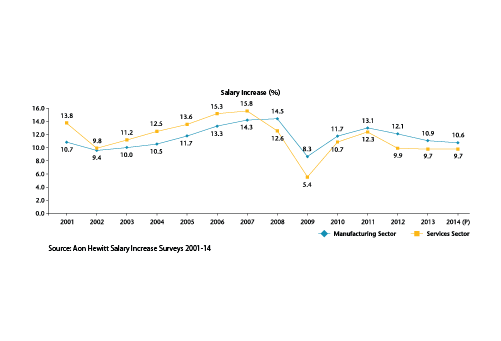
In fact, on further analyzing sectoral patterns in salary
increases across the last 14 years or so, it is evident that
increases in the manufacturing sector have remained fairly
stable. It is however, the increases in the services sector
that have reduced significantly in the period post the
global financial crisis. These are industries which have high
compensation costs as a percentage of revenue and hence
have been reducing
Top Talent to Thrive
With concerns over fluctuating economic conditions, India
Inc. turned to the Darwinian principal of natural selection;
‘only the strong shall survive’. With shrinking salary
increase budgets, the one definitive change observed in
the compensation philosophy of organizations in India
is the increased reinforcement of the performance and
rewards linkage. Top performers are projected to receive
an average 15.3% increase in 2014, almost 1.7 times
the average increment provided to employees meeting
expectations. Industries with the highest differentiation in
salary increases between a top and average performer are
telecom, retail and financial institutions (1.8:1), where
individual performance has a far bigger impact on business
performance. On the other hand, capital-intensive
industries such as energy, infrastructure and chemicals
reported the lowest differentiation (1.5:1 & 1.6:1) in salary
increases between a top and average performer.
Organizations are also ready to re-define what it takes
to be a top performer and ensure that the entry into this
|