Fortune Favors the Fittest
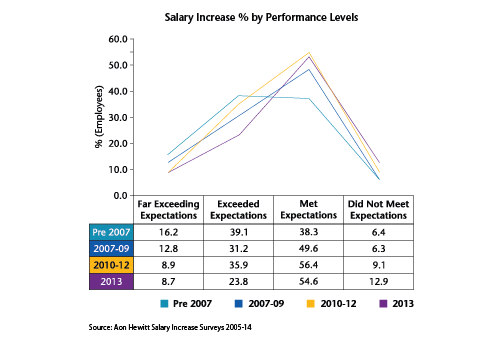
esteemed club isn't just a knock on the door. In the last five
years itself, i.e. since 2007, the percentage of employees in
the top performance rating has dropped by 30%, implying
that organizations are not hesitating to differentiate
sharply on the basis of performance and then allocating a
disproportionate share of the total increase budget to these
individuals, thus encouraging a high performance culture.
An increase of >100% in employees receiving the
lowest rating since 2007 coupled with 18% organizations
resorting to lay offs/redundancies as a measure to control
fixed cost escalation in the overall wage bill, further
confirms the Darwinian principal of survival of only the
fittest at the workplace!
In the face of increased cost prudence, the other
critical lever that organizations are using to reinforce the
performance and rewards linkage is variable pay. Spending
on variable pay as a part of total compensation has been
steadily growing over the past few years. This indicates a
shift in overall pay philosophy, as employers are tying a
greater percentage of each employee's pay to individual and
overall company performance. Top/Senior management
see 23% of their total compensation as variable (up
from 16% in 2001) and even the lowest rung entry level
management employee gets approximately 12% of their
salary as variable compensation (up from 10% in 2001).
Executive Compensation Too Inches Towards 'Pay for Performance'
The Executive Compensation Study 2013-14 confirms that progressively more and more HR departments are
facing a challenge of managing lower pay budgets for
the executive pay increases while ensuring sufficient
employee motivation. Client conversations reveal an
increasing interest of redefining the benefits and incentives
structure for the executive team to ensure that retention
hooks are established not just on short-term pay but also
through long-term for modes ensuring appropriate value
sharing between the management top team and the key
stakeholders. Over the last year, India has also witnessed a
fair amount of regulatory changes around compensation,
and related governance aspects. The Indian Parliament has
enacted the new Companies Act, 2013 in August followed
by updated rules in March 2014 resulting in a significant
overhaul on corporate governance norms in India
companies especially those which are publicly listed.
Hence, the Remuneration Committees are now facing a
three-pronged agenda – the need to drive performance, the
need to attract, retain and motivate executives with smaller
pay budgets, and a plethora of new governance and
regulatory changes.
Gradual Increase in Performance
Alignment
The study showed a growing discipline in determination
of top management compensation levels through higher
alignment of executive pay with both the business size
as well as the performance. The following charts show
the salary increase for executive positions witnessed from
FY2012-13 to FY2013-14 on different anchors of pay.
There is an increasing trend of loading higher pay
increases on variable compensation than on fixed for the
executive roles – this has further accelerated the change
in pay mix for executives with increasing quantum of pay
being delivered through performance-based elements. This
trend was specifically noted for critical functional and
business level positions.
|