As Health Spend Soars, Employers Should Beware of Hidden Cost Threats

As Health Spend Soars, Employers Should Beware of Hidden Cost Threats
November 25, 2025 9 mins

As Health Spend Soars, Employers Should Beware of Hidden Cost Threats

As Health Spend Soars, Employers Should Beware of Hidden Cost Threats

While cancer care and specialty medicines are familiar culprits behind rising U.S. healthcare costs, benefit leaders should also watch out for less obvious factors driving up expenses. Taking a holistic view requires being aware of these hidden threats as you work to manage costs.

Key Takeaways
  1. Hidden costs driven by AI upcoding, claim payment integrity program fees and regulatory influences are quietly inflating employer medical costs.
  2. Most employers are unaware of the full impact of the No Surprises Act, including high payouts resulting from its Independent Dispute Resolution process.
  3. It’s important to plan and mitigate where possible these lesser-known costs as employers take a holistic approach to managing healthcare budgets.

U.S. employer healthcare costs are projected to soar almost 10% for 2026 to $17,000 per employee. This is the third consecutive year of nearly double-digit cost increases.1 While chronic conditions and high-priced drugs understandably receive a lot of attention for contributing to the trend, they only tell part of the story.

Today, an emerging set of “hidden” costs are quietly driving budgets ever higher. Fees tied to complex program structures, unexpected impacts from recent government regulations and advanced billing methods powered by artificial intelligence (AI) are often falling under the radar given how complex managing healthcare and benefit costs has become. However, understanding and addressing these lurking risks is critical as employers look to manage their budgets and ensure healthcare remains affordable for plan members as well.

“We’re finding that most employers have little insight into how much these hidden costs are impacting their health plans. Most companies only realize their significance when it’s too late to avoid these costs,” says Mike Clarke, Senior Vice President, Health Solutions, North America at Aon.

3 Hidden Healthcare Cost Drivers in the U.S.

  • 01

    Claims Payment Integrity (CPI) Program Fees

    These programs are designed to prevent losses from fraud, waste, errors and abuse in health claims. But the fees are high, and improper payments remain a problem — accounting for around $100 billion in waste in Medicare and Medicaid programs annually.2

  • 02

    Independent Dispute Resolution (IDR) in the No Surprises Act

    The IDR process frequently awards settlements as high as 1,000% or more of standard rates, with 86% of decisions favoring providers.3 This drives out-of-network claim costs higher while also layering on unexpected administrative expenses associated with IDR arbitration.

  • 03

    AI-Driven Upcoding and Overbilling

    Providers are increasingly using AI to code claims at higher intensity, which can boost charges for even basic services. This recent trend is largely invisible to benefit leaders but can quickly escalate costs. The risk can be financial, ethical and even legal if not closely managed.

Strategies for Addressing Hidden Costs

While they can’t always be avoided, combining these strategies with careful planning will allow employers to forecast a more accurate benefits budget and ensure they are taking every step to mitigate costs under their control.

Mitigation Measures for CPI Program Fees

There are three key strategies that can help address these fees, and in some cases, save employers considerable cost.

  • Adjust program fees

    While these programs can save money by catching fraud, waste, abuse and errors, insurers or third-party administrators can charge employers steep fees for the service.

    “Instead of paying a fee of 30% to 50%, which we often see, it’s optimal to negotiate it down to 15% to 20% of the negotiated savings,” explains Aon’s Clarke. “I’d also advise negotiating a fee cap on a per member or per claimant basis.” This is particularly useful, Clarke says, in situations where a plan member is going out of network for a costly procedure. In this case, CPI fees may be 50% of savings based on a surgery that is hundreds of thousands of dollars.

  • Ensure auditing is thorough

    Auditing is another important tactic to avoid excessive costs. Employers should insist on detailed breakdowns from carriers and vendors about all program fees. We recommend spot checks and quarterly audits to help catch trends earlier. When conducting shared savings program audits, Aon has discovered in some cases clients are overpaying their program fees due to administrative issues and how those have been set up in the system.

    In one situation, we were hired to conduct an audit for a large national company that had negotiated a reduced shared savings fee percentage that was lower than the carrier’s standard rate. Our review of the Special Investigation Unit shared savings category determined the carrier was applying the standard fee rate and not the reduced rate. In this case, the incorrect percentage rate was applied for three years to the shared savings program, resulting in an impact to the client in the amount of over $500,000. Full reimbursement was provided to the client by the carrier. The overall ROI for the audit was over 700%.

    Our audit practice has uncovered some of the following errors related to shared savings fees:

    • non-network provider discounts
    • the continuation of fees applied after the order of other insurance primacy has been confirmed
    • incorrect percentage rates applied to fees
    • duplicate fees assessed
    • incorrect benefit calculation
    • eligible services denied by software
    • data mining issues
    • fees applied to overpayment recovery
    • special investigation recovery
    • claim payment editing
  • Address OON providers

    Another focus point should be with high-cost out-of-network (OON) providers. Work with your carrier to see if they can bring OON providers that are used frequently by plan members within its provider network.

How to Maximize Claims Payment Integrity Programs: Pre-Submission to Post-Payment
Cost Avoidance Pricing and Grouping Claim Editing Claim Review Subrogation Recovery
Identify and prevent improper claims before service occurs. Ensure claims are priced at contracted rates and services grouped accurately. Check claims for errors/issues, verify coding accuracy and compliance. Examine claims to ensure they meet the plan’s criteria for payment. Recover costs from third parties responsible for healthcare expenses. Reclaim funds that have been paid out incorrectly or in excess.
Mitigation Measures for the IDR Process

The goal of the No Surprises Act was to protect patients from unexpected medical bills related to out-of-network costs, such as emergency services, non-emergency services provided during a visit to an in-network facility or air ambulance services. In order to pay providers fairly, the Act requires a 30-day open negotiation period between the health plan and the provider. If an agreement is not reached, either party can request an IDR. The challenge for employers is that IDR decisions have predominantly favored providers and payouts are much higher than the qualified payment amount (QPA). The QPA is the median contracted rate that a health plan has with providers for a specific service in a geographic area. There are also several fees that the parties need to pay to go through IDR.

“Given that providers are winning a majority of IDR cases with substantial reward amounts, there is increasing suspicion that providers appear to have incentive to bypass the 30-day negotiation period and resolve through the IDR process,” explains Tejesh Patel, Vice President in Aon’s Health Solutions practice in North America.

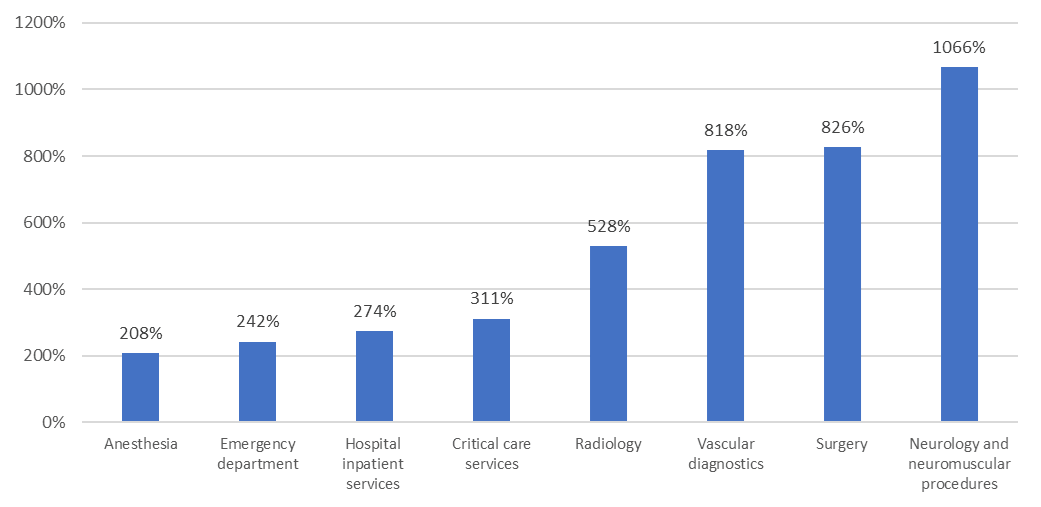
In the past four years, average IDR settlement amounts have been 10 times the qualified payment amount.

IDR Settlement Amounts for Select Services Exceed QPA
As Health Spend Soars, Employers Should Beware of Hidden Cost Threats Diagram

Source: KFF analysis of CMS data, data from Q1 2023 through Q2 2024

Mitigation Measures for AI-Driven Upcoding

Whether intentional or not, provider use of AI tools is resulting in escalated service intensity in claim submissions. This can lead to higher costs for payers and employers.

Consider the following situation: A patient visits their physician for an annual exam. The provider uses an AI tool to record patient observation notes and that tool summarizes the conversation. When the physician mentions that in the future the patient may need surgery to address chronic back pain, the AI tool picks that up and makes it a central takeaway of the visit. Therefore, the visit is coded at a higher intensity level than the visit otherwise would have been, leading to a higher charge from the provider for the visit.

“Addressing this issue requires a combination of strong governance, technical transparency, regular monitoring, education and careful vendor management,” says Debbie Ashford, Aon Health Solutions Chief Actuary.

She recommends requesting the following actions from your carriers:

  • Create an AI oversight committee
  • Require algorithm documentation
  • Routinely review claims
  • Coding compliance workshops
  • Third-party audits
  • Anonymous reporting hotline
  • Update policies as new rules or best practices are adopted

186%

There has been an 186% increase in closed cases from IDR between the first quarter 2023 and first quarter 2024.

Source: Centers for Medicare & Medicaid Services Independent Dispute Resolution Reports

Invest in Training and Predictive Analytics for Long-Term Resilience

Hidden healthcare cost drivers are constantly evolving. While today’s issues center on recent regulations and emerging trends such as AI, future risks may not even be on the radar of health and benefit professionals.

The way to ensure hidden costs are identified and mitigated early is through embedding training, education and predictive analytics. Ensure regular training with HR, benefits and finance teams to discuss and better understand the latest risks, regulatory shifts and data trends. Use predictive analytics to identify high-cost outliers and emerging risks early.

Ultimately, making hidden cost management the foundation of your health plan strategy is more than financial prudence; it’s essential for long-term resilience and protection.

Contact us to learn more about how Aon can help.

Aon’s Thought Leaders
  • Debbie Ashford
    Chief Actuary, Health Solutions, North America
  • Mike Clarke
    Senior Vice President, Health Solutions, North America
  • Crystal Norris
    Vice President – Audit Practice Manager, Health Solutions, North America
  • Tejesh Patel
    Vice President – Actuary, Health Solutions, North America

General Disclaimer

This document is not intended to address any specific situation or to provide legal, regulatory, financial, or other advice. While care has been taken in the production of this document, Aon does not warrant, represent or guarantee the accuracy, adequacy, completeness or fitness for any purpose of the document or any part of it and can accept no liability for any loss incurred in any way by any person who may rely on it. Any recipient shall be responsible for the use to which it puts this document. This document has been compiled using information available to us up to its date of publication and is subject to any qualifications made in the document.

Terms of Use

The contents herein may not be reproduced, reused, reprinted or redistributed without the expressed written consent of Aon, unless otherwise authorized by Aon. To use information contained herein, please write to our team.

More Like This

View All
Subscribe CTA Banner