Risk Factors and Conditions Driving the Global Medical Trend Rate

Risk Factors and Conditions Driving the Global Medical Trend Rate
November 17, 2025 8 mins

Risk Factors and Conditions Driving the Global Medical Trend Rate

Risk Factors and Conditions Driving the Global Medical Trend Rate

The global medical trend rate is projected to dip below double digits for the first time in three years to 9.8%. It may be a hopeful sign that cost increases have plateaued, but cost increases are still elevated. We explain the risks and conditions behind the increase so employers can prepare.

Key Takeaways
  1. Certain risk factors and medical conditions are inescapable while others driving the trend vary by region for many reasons, including population demographics, economic impacts and cultural factors.
  2. High blood pressure remains the top cost-driving risk factor and one of the top conditions driving costs — both globally and within many regions.
  3. Understanding the risk factors and conditions behind rate increases can help companies develop a long-term strategy to mitigate costs.

Amid economic uncertainty and cooling inflation in much of the world, the projected 2026 global medical trend rate has eased slightly to 9.8%, according to Aon’s Global Medical Trend Rates Report 2026. This marks the first time in three years that the rate is less than 10%. However, there is still upward pressure on costs thanks to macroeconomic factors like trade uncertainty and healthcare-specific factors such as higher utilization. Other regional-specific variations also contribute to the overall trend.

“While the overall trend rate may be starting to stabilize, that doesn’t mean costs are coming down,” says Kathryn Davis, vice president of global benefits at Aon. “The rate of increase has slowed, but economic instability, global uncertainty and worsening strain on public medical systems mean higher costs are likely still inevitable for the foreseeable future.”

The health risks and medical conditions driving the overall trend rate have varied little over the last few years, though there are some differences both over time and regionally. Notably, the top conditions are commonly lifestyle related, meaning that employee behaviors can influence outcomes. The risks and medical conditions that drive claims are key to understanding where and why the trend rate has risen and what can be done to help mitigate future increases.

Risk Factors Driving the Medical Trend Rate

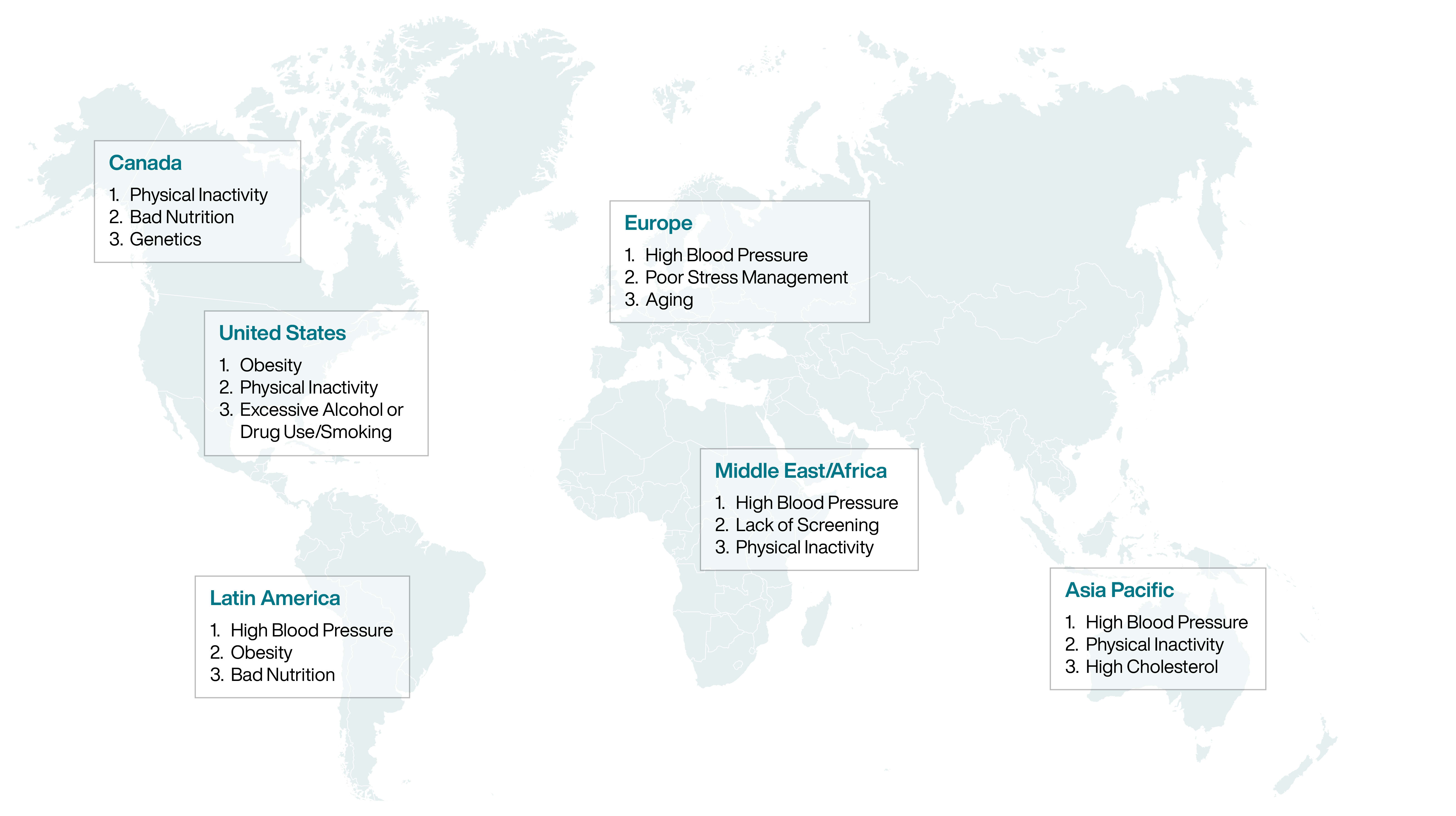
Risk Factors and Conditions Driving the Global Medical Trend Rate Diagram 1

It is important to consider the multiple risk factors and conditions driving the trend rate together. The top risk factors that drive claims can work alone or in combination with other risk factors. For example, poor stress management, bad nutrition and lack of physical activity are all linked to hypertension, which is both a condition and a risk factor driving claims.

Top Risk Factors Globally:

  1. Hypertension, or high blood pressure, is once again the leading risk factor globally. It was mentioned as the top risk in every region except North America and has been the top risk factor globally every year since 2019. Screening for hypertension is easy and widespread, allowing for early detection and diagnosis. However, since hypertension is a risk factor for so many other medical conditions, requires long-term treatment and is widespread, it’s a larger driver of claims.
  2. Second on the list, for the seventh consecutive year, is physical inactivity, which can lead to musculoskeletal issues, obesity and cardiovascular problems. Until this year, physical inactivity ranked as the top risk factor in the U.S. for nearly a decade. It remains the top risk factor in Canada and is in the top three in the U.S., APAC and the Middle East and Africa.
  3. Poor nutrition is the third most impactful risk factor, with obesity fourth and high cholesterol fifth. It’s easy to connect these risk factors, as they can all be linked to diet and other lifestyle factors, though obesity and high cholesterol have genetic components as well. Poor nutrition is considered a top risk factor in every region except for Europe and is found in both richer countries and less economically developed areas. Each of these risk factors are themselves risk factors for high blood pressure and cardiovascular issues (which is the leading medical condition driving costs globally). Also, like hypertension, the intervention for high cholesterol can be medicinal, diet-related or both, with medicinal treatment contributing to ongoing claims cost.
Lifestyle factors

Spotlight

Lifestyle factors

Many of the top risk factors share a common element — they are related to individual lifestyle. Obesity, physical inactivity, excessive drug and alcohol use and poor nutrition can all be related to lifestyle choices. Others, like hypertension, can be lifestyle or genetics based. Interventions like GLP-1s show promise in treating some lifestyle-based risk factors. There is early evidence that they can not only help with blood sugar and weight management but may also be helpful in addiction treatment. Employers should keep these lifestyle-based interventions in mind when designing benefit programs. However, there is no one-size-fits-all approach; costs must be balanced against each organization’s unique workforce.

Conditions Driving the Medical Trend Rate Stay Consistent

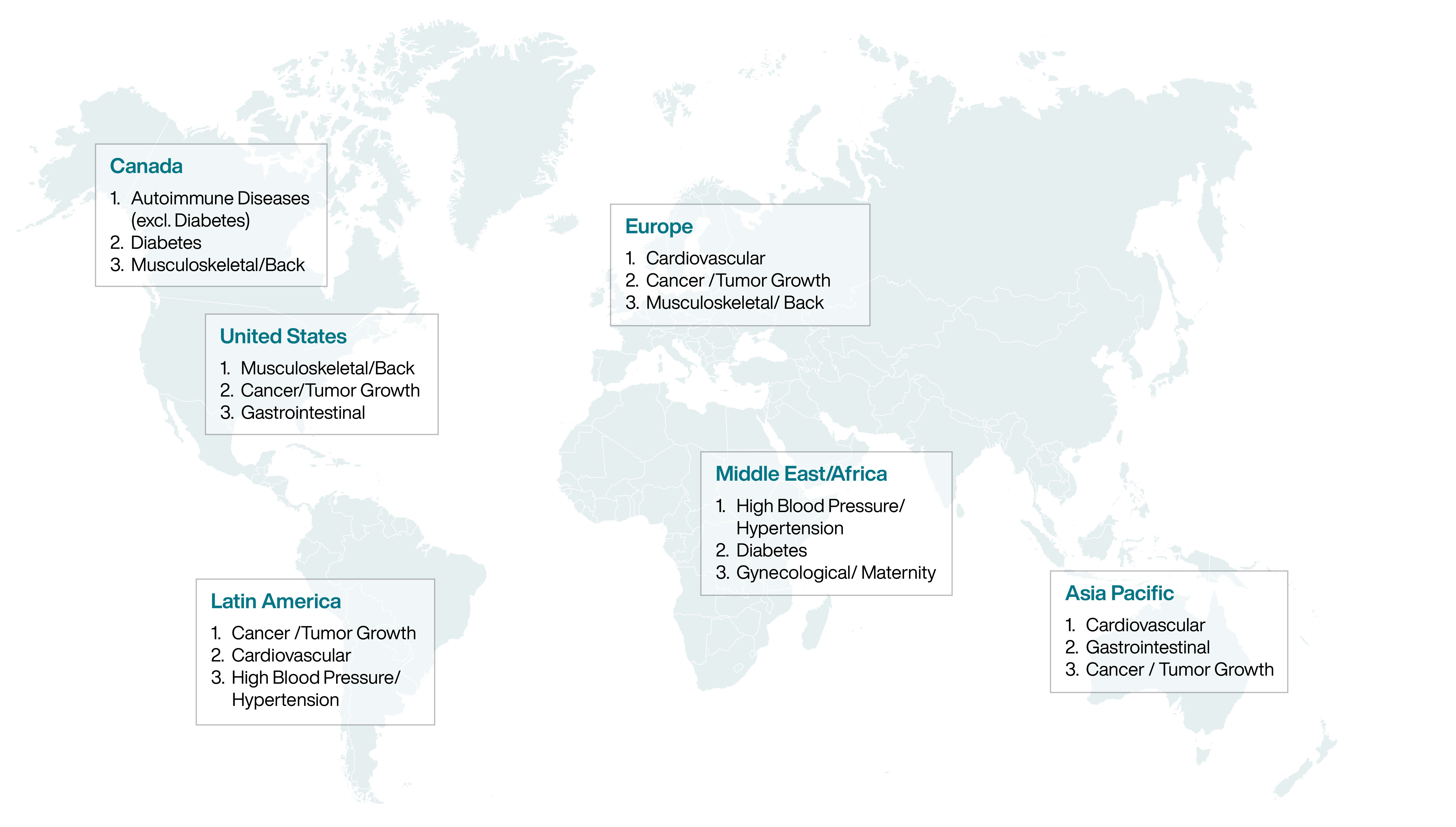
Risk Factors and Conditions Driving the Global Medical Trend Rate Diagram 2

The top three conditions driving the medical trend rate higher are the same as reported in 2025 and have been almost completely identical since 2021. As with risk factors, that doesn’t mean these conditions are the only drivers of the medical trend rate, or that all of them are the same globally.

Top Medical Conditions Globally:

  1. Cardiovascular issues, including heart attacks and strokes, are among the most commonly reported conditions and usually the most expensive, given the emergency interventions needed to prevent long-term damage or death. Globally, more than 19 million people die from cardiovascular disease each year.1 High blood pressure, poor stress management, obesity, poor nutrition and lack of physical activity are all major risk factors for cardiovascular disease, many of which are the top reported risk factors as previously noted. Emerging preventative weight management treatments, such as GLP-1 medications, may help mitigate this cost in future but also contribute to higher costs in their own right.
  2. There is much that is not understood about the causes of cancer, apart from some behavioral triggers like smoking. This makes effective prevention a challenge. That’s one reason why cancer/tumor growth continues to be a major driver of claims. Successful cancer treatment often depends on early detection and timely intervention. Delays in these actions are associated with poorer prognoses, leading to higher treatment costs. Screenings, as well as interventions (e.g., surgery, radiation treatment), also require timely, in-person interactions. Additionally, hindered access to care and delay in seeking care as a result of post-pandemic strains on healthcare systems are likely amplifying cancer treatment costs.
  3. Hypertension again shows up as both a risk factor and condition requiring treatment. Hypertension drugs make up 80% of the total cost of treatment.While the cost of these drugs is relatively low when compared to expensive cancer treatments and emergency interventions of cardiovascular disease patients, the sheer number of people needing the drugs accounts for the high overall cost.
  4. Diabetes was the fourth most impactful medical condition driving the trend rate and is underdiscussed as a driver of claims. Patients with long-term diabetes can encounter complications in multiple systems, from neurological and gastrointestinal to vision and more. Medications used to treat diabetes include insulin, the cost of which can vary widely from country to country, and the class of medications known as GLP-1s, which are used to help with the absorption of insulin. These medications generate both high volumes of claims and high-cost claims thanks to the cost of the drugs and the ongoing nature of treatment. And while more than one in nine people globally are living with diagnosed cases of diabetes worldwide, it is likely still underdiagnosed.3
  5. Finally, musculoskeletal/back issues have emerged as a top five source of claims after years of increasing impact. These conditions are inherent to sedentary lifestyles and stress. They are also expensive to address and often require long-term treatment.

Taking a Holistic, Data-Led Approach

The data from Aon’s Global Medical Trend Rates Report 2026 represents a snapshot of the global healthcare ecosystem. The nuance associated with medical costs can vary widely from country to country, spurred by variations in types of healthcare systems, and even from employer to employer. Given that complexity, employers should adopt a holistic, data-driven strategy to control costs and support behavioral change. Companies have a large amount of data at their disposal and using that data to identify and understand what is driving their own claim costs can lead to meaningful progress.

Learn how Aon can help your organization understand cost drivers and how to mitigate them. Contact us today.

Aon’s Thought Leaders
  • Kathryn Davis
    Vice President, Global Benefits
  • Mike Pedel
    Head of Global Benefits
  • Carl Redondo
    Global Benefits Consulting Leader
  • Céline Ng Tong
    Global Business Development Director
  • Jill Malila
    Global Benefits Consulting Leader, North America

General Disclaimer

This document is not intended to address any specific situation or to provide legal, regulatory, financial, or other advice. While care has been taken in the production of this document, Aon does not warrant, represent or guarantee the accuracy, adequacy, completeness or fitness for any purpose of the document or any part of it and can accept no liability for any loss incurred in any way by any person who may rely on it. Any recipient shall be responsible for the use to which it puts this document. This document has been compiled using information available to us up to its date of publication and is subject to any qualifications made in the document.

Terms of Use

The contents herein may not be reproduced, reused, reprinted or redistributed without the expressed written consent of Aon, unless otherwise authorized by Aon. To use information contained herein, please write to our team.

More Like This

View All
Subscribe CTA Banner