Assess D&O Risks Before Going Public
It is essential for private companies to review and evaluate directors’ and officers’ exposures before beginning the
IPO process. Significant distinctions exist between directors and officers (D&O) insurance policies for private
and public companies.
Ensuring the right protection for corporate directors and key executives is paramount for a variety of financial and
operational reasons. This includes meticulously evaluating D&O liability insurance coverages to safeguard
business leaders. The importance of disclosures and their increased risk cannot be overstated. Reider
emphasizes: “The disclosure piece of the private-to-public transition is fraught with risk — particularly given
the broad IPO misstatement liability provisions under Section 11 of the U.S. Securities Act of 1933.”
D&O placement conditions for IPOs remain favorable, with competitive pricing, capacity, and terms over the last 6–12
months, even as insurers deploy capital carefully in light of persistent securities litigation risk for newly
public companies. While dynamics remain competitive, outcomes are highly dependent on each company’s specific
risk profile.
Reider adds that carriers are offering public company entity investigation and IPO underwriter-related coverages to
differentiate themselves in the market. “The market is still relatively favorable for buyers, and this extends
not only to pricing, but also to coverage. Carriers, for example, are currently more inclined to offer entity
investigation and IPO underwriter coverage. That's something that public company forms typically don't have, but
we're seeing it offered as a way for carriers to compete and distinguish themselves.”
Getting Risks, Terms and Policy Structure Right
When transitioning from a private to a public company, businesses should prioritize the fundamental shift in risk
dynamics and focus on structuring effective de-risking strategies. Beginning at the “all hands” initial kick-off
meeting and through the road show, company leaders are making decisions and representations that could create
liability exposures.
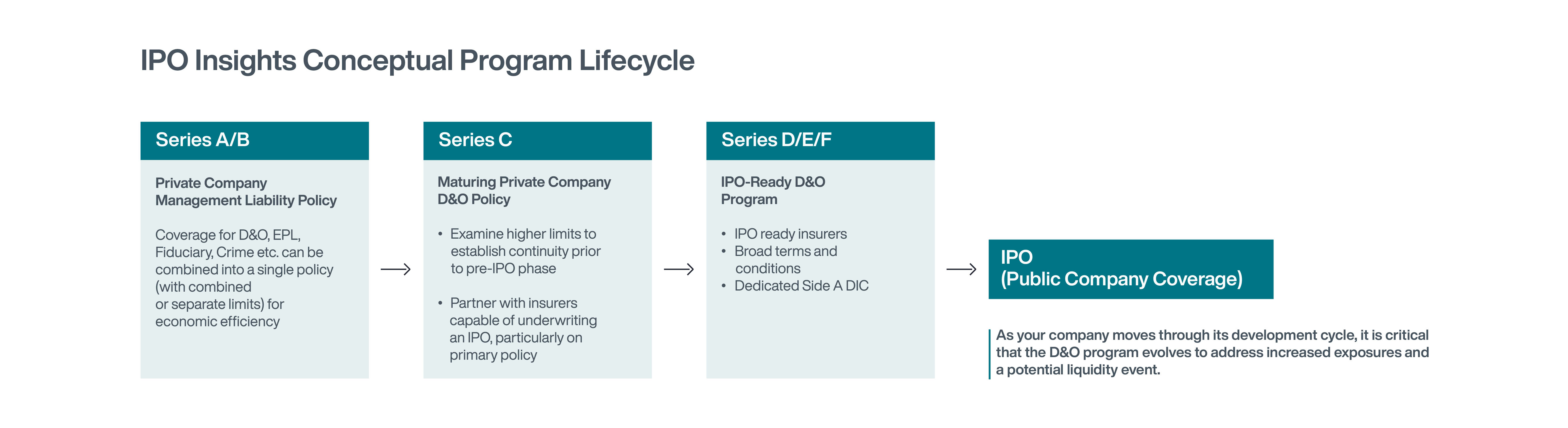
IPO candidates should confirm that their current private company D&O program terms, structure and limits provide
the necessary pre-IPO coverage for a seamless transition to public company status.