April 20, 2026 9 mins
Building Tomorrow’s Grid: Managing Extreme Heat Risk in a Warming World

Extreme heat from climate change is increasingly threatening U.S. energy supply and reliability – forcing energy companies to take steps to safeguard operations and meet rising demand.
Key Takeaways
-
Extreme heat from climate change is increasingly threatening U.S. energy supply and reliability, especially for fossil-fuel power plants, as electricity demand rises.
-
By 2050, billions of dollars in economic value, and up to 18% of U.S. generating capacity from fossil fuel power plants could be exposed to heat risk.
-
Energy companies should diversify sources, strengthen infrastructure, and factor climate risk into planning to safeguard operations and meet rising demand.
Rapid growth and investment in Artificial Intelligence (AI) and its power-hungry data centers is driving one of the greatest expansions of the U.S. energy grid since its inception in the late 1800s. As new generation facilities come online, energy companies, and the businesses that rely on them, need to understand how climate change will impact these critical resources.
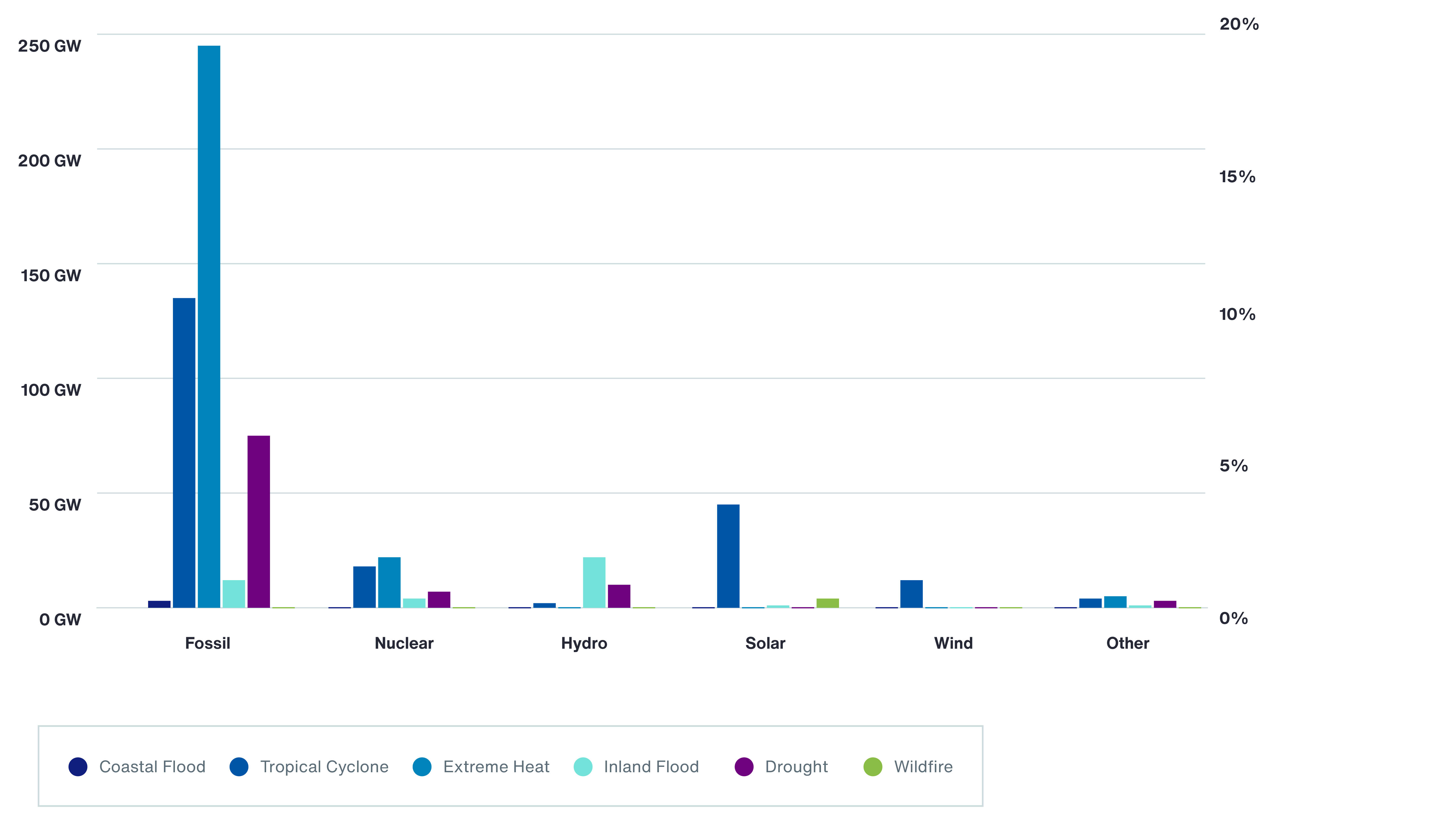
By 2050, about $228B of economic value from the utilities sector in the U.S. will be generated in areas highly exposed to extreme heat, compared to only $16B today1, according to new insight from Aon’s Climate Risk Monitor. The climate analytics tool combines sector-specific vulnerability with forward-looking climate projections to estimate how much power generation is expected to be at risk to various extreme weather events. Fossil-fuel thermoelectric plants are the most at risk, with up to 243 GW or 18% of total generating capacity expected to be at high risk from heat by 2050 (Fig. 1). That is enough electricity to power more than 40 cities the size of New York City during peak demand.
Given the high risk it poses, and the scientific certainty of increasing extreme heat in the future, we take a deeper look at its impact on thermoelectric power generation.
Figure 1: Generating Capacity at High Risk in 2050, by Peril and Fuel Source
The figure illustrates how much power‑generation capacity is expected to face high climate risk, which hazards drive that exposure, and the fuel types most vulnerable.
$228B
Of economic value from the U.S. utilities sector exposed to extreme heat by 2050 according to insight from Aon's Climate Risk Monitor.
Why is Extreme Heat So Important?
Heat impacts both the supply and demand sides of electricity. It reduces generator capacity and transmission efficiency, while simultaneously stressing the demand side as air conditioning use surges. As a result, forced outages and rolling blackouts rise significantly during extreme heat events, compounding health risks to vulnerable populations, and causing a cascade of negative socio-economic impacts. It’s estimated that weather-driven power outages cost the U.S. $20-50 billion annually2.
Thermoelectric power plants that rely on steam to spin a turbine—including both fossil fuel and nuclear sources— account for over 70 percent of total U.S. power generation3 and are especially vulnerable to increasing heat for three key reasons:
- Reduced efficiency and capacity – As ambient temperatures climb, turbines lose efficiency, producing less electricity for the same fuel input. It’s estimated that climate change could reduce the average capacity of U.S. thermoelectric plants around 5-15% by 20504.
- Increased water needs, reduced supply - Heavy reliance on water for cooling and hotter conditions mean more water is required to prevent overheating, leading to increased costs and lost capacity, which can be further compounded by reduced water supply from the co-occurrence of extreme heat and drought in a warmer climate5.
- Curtailments and shutdowns - During periods of extreme heat, some plants are forced to dial back production or shut down altogether to avoid equipment damage or environmental violations tied to water discharge temperatures. Between 2000-2015 in the U.S.6, 43 such instances occurred7, and more than 30 European plants were forced to shut down during the 2003 heatwave alone8.
Measure What Matters
Heat has sweeping impacts, not just across the energy sector, but also across health, agriculture, and construction, among others. Tailoring climate data to sector-specific needs is critical to ensure that risk managers, planners, and regulators can properly assess the relevant impacts of climate change.
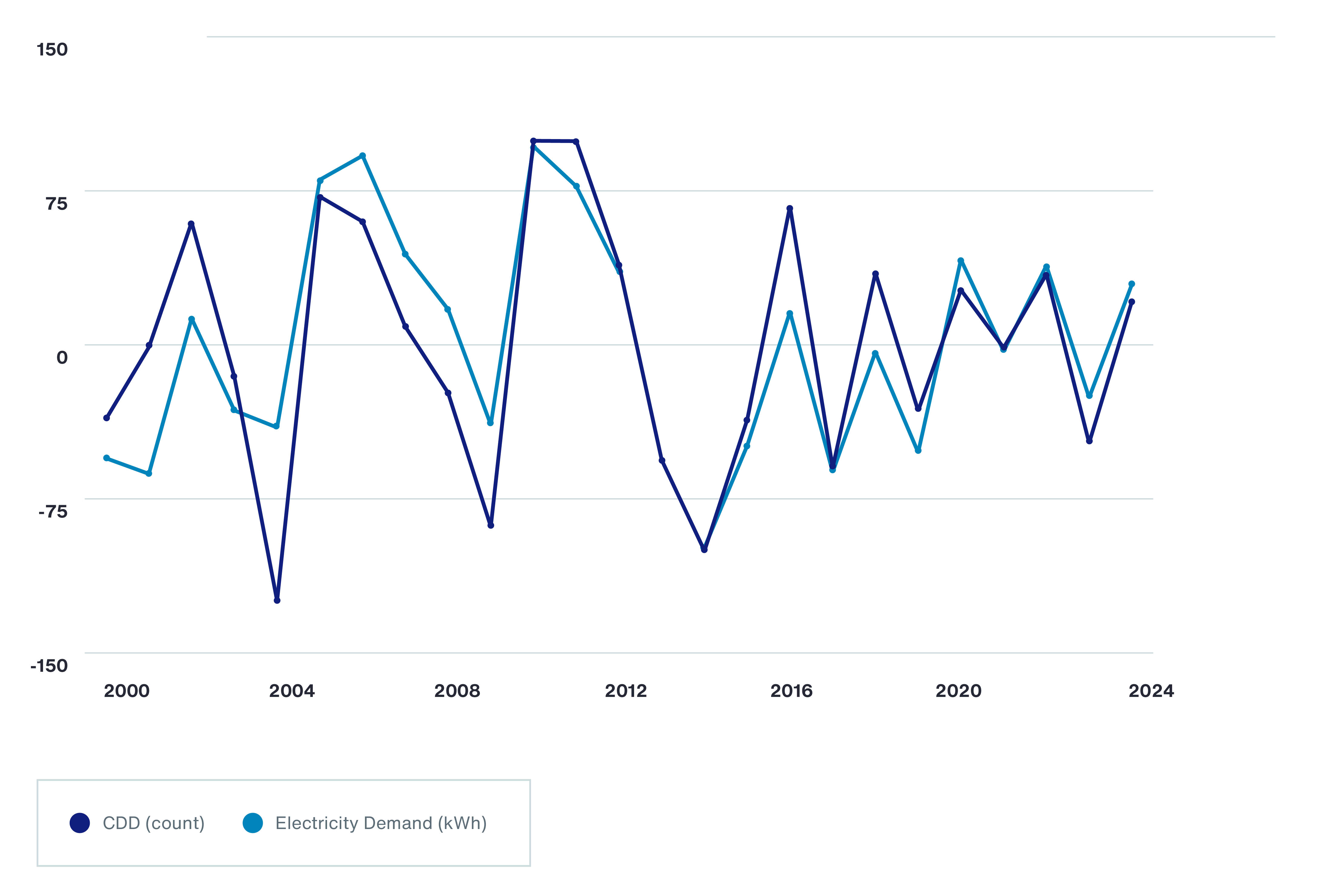
Cooling degree days (CDD) is a heat metric of specific relevance to the energy sector. By measuring how much temperatures are above a specific threshold likely needed for air conditioning (usually 65°F), they’re directly proportional to the amount of electricity needed to cool a building. CDD thus serve as a valuable predictor of weather-driven changes in energy demand, with historical fluctuations in summer electricity highly correlated with changes in CDD (Fig. 2).
Figure 2: Relationship of Summer Heat and Electricity Demand
Correlation of summer residential electricity use (per capita) and summer cooling degree days (CDD). Time series are detrended to isolate near-term variability due to weather based on data from the U.S. Energy Information Administration with analysis by Aon.
70%
of total U.S. power generation are especially vulnerable to increasing heat.
Rising Demand in a Warming World
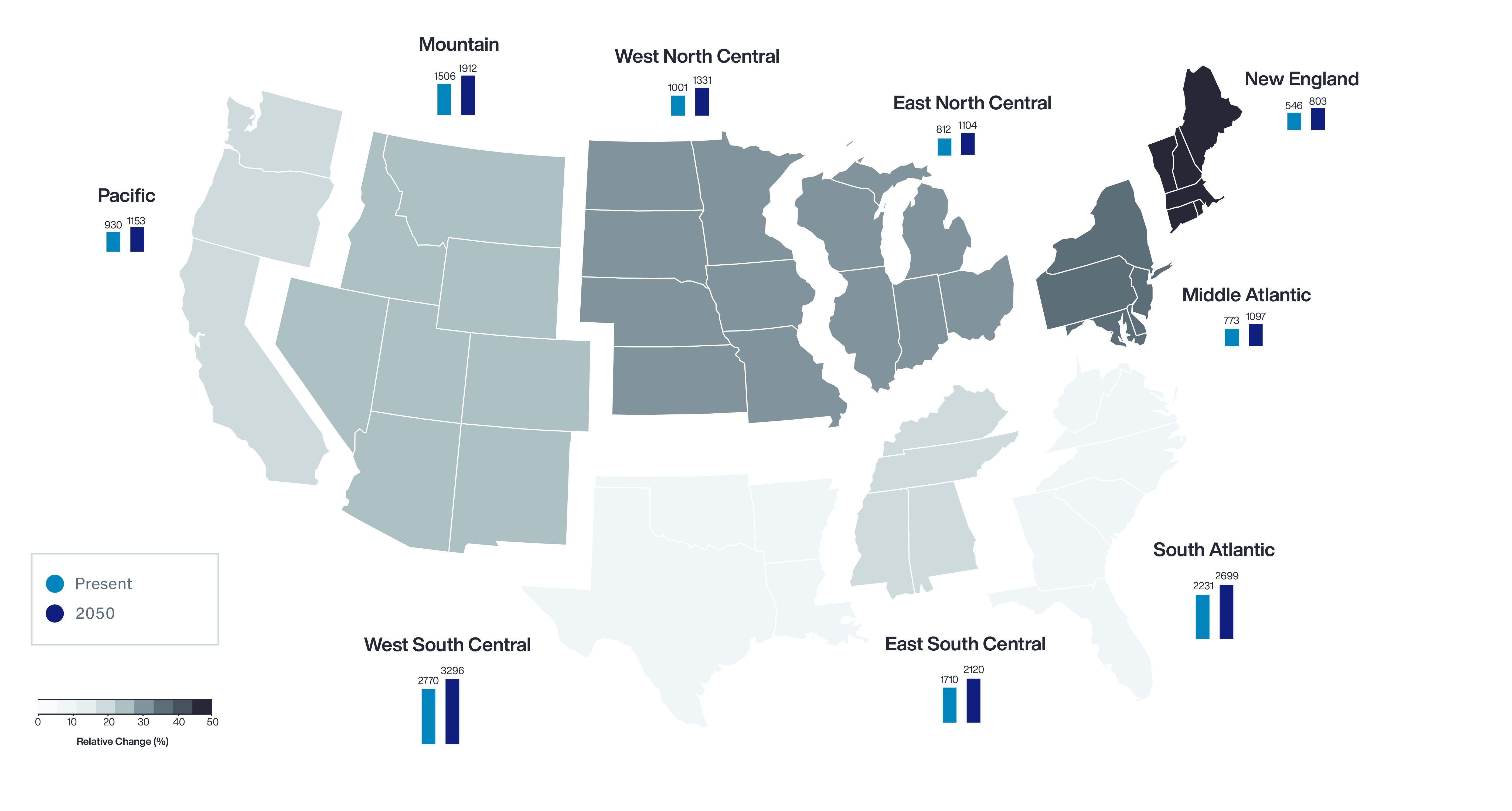
By combining historical CDD data with forward looking projections from Aon’s Climate Risk Monitor, we can estimate climate-driven trends in energy demand across different regions of the U.S. Figure 3 shows the changes in the average CDD per year for each census region, where CDD data is weighted by population for a more accurate measure of how warming temperatures will affect cooling demand.
Rising temperatures will increase air conditioning usage nationwide, extending cooling needs in already hot regions like the West South-Central region, and creating new demand in areas that previously needed little or none, like New England. Increases of 20-50% can be expected by year 2050 under a “moderate” future climate scenario where global warming reaches about 2.0°C by mid-century.
Figure 3: Climate-Driven Trend in Cooling Demand
Projected mid-century changes in population-weighted Cooling Degree Days (CDD) by U.S. Census Division under a “Middle of the Road” SSP2-4.5 climate scenario based on data from U.S. Energy Information Administration, U.S. Census Bureau and Aon’s Climate Risk Monitor.
Aon Capabilities
-
Capability Overview
Climate Risk Advisory
-
Industry Overview
Natural Resources
-
Capability Overview
Broking and Risk Transfer
The negative impacts of extreme heat on thermoelectric power supply and efficiency come just as electricity demand is set to accelerate. At the same time, the exponential growth of AI and data centers is creating a new source of additional demand9. The result is a widening gap: climate change makes it harder for existing plants to produce electricity at levels they previously could, while the nation’s need for electricity is only growing.
Preparing for What’s Next
The U.S. will need to expand energy capacity significantly in the coming decades to meet rising demand. It is critical that climate is considered in this expansion to ensure that the grid can be resilient amid increasing risk from climate change.
The stakes are high. Without planning for extreme heat impacts, the U.S. risks building additional capacity on a shaky foundation – expanding power generation while not accounting for mounting climate risks. However, with proper risk identification, quantification, informed adaptation and strategic investments, the energy sector can navigate climate risk while meeting rising demand.
- Diversification is essential – Different energy sources have different vulnerabilities to climate risk. A healthy mix of renewable sources along with thermoelectric generation can help increase grid reliability by reducing the risk to extreme heat.
- Increase infrastructure resilience – Infrastructure upgrades are effective measures to adapt to heat events. For thermoelectric power plants, this means investing in advanced cooling technologies and improved water management strategies to maintain reliable output and avoid curtailments.
- Integrate climate risk in investments - Integrating climate risk into the investment strategy of large-scale commercial facilities like data centers and power plants can help ensure operational continuity and financial protection, by identifying climate resilient site selection and technologies, and helping to secure more favorable insurance coverage.
1 Analysis assumes a “Middle of the Road” SSP2-4.5 climate scenario with future contribution to total
U.S. GDP by the utilities sector held fixed at present day value (~1.6%).
2 Saki,
S., Sofia, G., Kar, B. et al. A multi-year analysis of the impact of heatwaves and compound weather events on
power outages. Sci Rep 15, 30846 (2025).
3 What is U.S. electricity generation by energy source?
4 van Vliet, M.,
Yearsley, J., Ludwig, F. et al. Vulnerability of US and European electricity supply to climate change. Nature
Clim Change 2, 676–681 (2012).
5 McCall, J.,
Macknick, J., and D. Hillman. 2016. Water-Related Power Plant Curtailments: An Overview of Incidents and
Contributing Factors. Golden, CO: National Renewable Energy Laboratory. NREL/TP-6A20-67084.
6 International Atomic Energy Agency (2004). “Operating experience with nuclear power stations in member
states in 2003.”
7 Powering the US Data Center Boom: Why Forecasting Can Be So Tricky
General Disclaimer
This document is not intended to address any specific situation or to provide legal, regulatory, financial, or other advice. While care has been taken in the production of this document, Aon does not warrant, represent or guarantee the accuracy, adequacy, completeness or fitness for any purpose of the document or any part of it and can accept no liability for any loss incurred in any way by any person who may rely on it. Any recipient shall be responsible for the use to which it puts this document. This document has been compiled using information available to us up to its date of publication and is subject to any qualifications made in the document.
Terms of Use
The contents herein may not be reproduced, reused, reprinted or redistributed without the expressed written consent of Aon, unless otherwise authorized by Aon. To use information contained herein, please write to our team.
Aon's Better Being Podcast
Our Better Being podcast series, hosted by Aon Chief Wellbeing Officer Rachel Fellowes, explores wellbeing strategies and resilience. This season we cover human sustainability, kindness in the workplace, how to measure wellbeing, managing grief and more.
-

Podcast 23 mins
Better Being Series: Understanding Burnout in the Workplace -
Podcast 14 mins
Better Being Series: Why Nutrition Matters -
Podcast 10 mins
Better Being Series: Discover the ‘Blue Zones’ Where People Live Longer -
Podcast 20 mins
Better Being Series: Improving Your Financial Wellbeing -
Podcast 17 mins
Better Being Series: Are You Taking Care of Your Digital Wellbeing? -
Podcast 19 mins
On Aon Podcast: Better Being Series Dives into Women’s Health -
Podcast 25 mins
On Aon’s Better Being Series: Managing Loss and Grief

Aon Insights Series Asia
Expert Views on Today's Risk Capital and Human Capital Issues
-

Article 8 mins
Thriving in an Interconnected World: How the C-Suite Embraces Uncertainty -

Article 6 mins
Powering Progress: Collaborating to Build a Sustainable Future in Emerging Markets -

Article 5 mins
Building Business Resilience: Key Steps to Effectively Integrate Risk Management Across Your Organisation -

Article 7 mins
Why Humans Are the Essential Factor in the Success of Artificial Intelligence (AI) -

Article 5 mins
Leveraging Research and Expertise to Strengthen Your HR Strategy for 2025 and Beyond -

Article 5 mins
Managing Risk on the Energy Transition Journey -

Article 7 mins
The Role of Risk Management in the Age of Generative Artificial Intelligence -

Article 7 mins
Finding A Way In Asia Pacific's New Economic Reality -

Article 4 mins
Three Ways to Boost Value from Benefits: APAC Insights from LinkedIn


Aon Insights Series Pacific
Expert Views on Today's Risk Capital and Human Capital Issues
-

Article 3 mins
Article Template to Duplicate

Aon Insights Series UK
Expert Views on Today's Risk Capital and Human Capital Issues
-

Article 2 mins
Introduction: Clarity and Confidence to Act Now -

Article 11 mins
Navigating a New Age of Macroeconomic Uncertainty -

Article 3 mins
Making Better Decisions — A C-Suite Perspective -

Article 3 mins
Understanding the Dynamics of Today’s Workforce — Reward, Retain, Evolve -

Article 3 mins
Artificial Intelligence — Managing the Risk and Potential -

Article 10 mins
Unlocking Balance Sheet Value to Empower Your Business Strategy -

Article 3 mins
Navigating the Unpredictable: Aon’s Suite of Actionable Analytics -

Article 4 mins
Redefining Risk Capital as a Business Enabler: Veolia's Innovative Approach -

Article 9 mins
A Data-Driven Approach to Better Workforce Decisions -

Article 5 mins
The Importance of Pay Transparency -

Article 6 mins
How Human Capital Data Enhances Risk Management for Financial Institutions -

Article 4 mins
The Battle for Top Talent in the Professional Services Sector -

Article 5 mins
Insights on a Volatile World — Risk Factors That Businesses Need to be Monitoring


Client Trends 2025
Better Decisions Across Interconnected Risk and People Issues.
-

Article 3 mins
Acknowledging Our Complex Reality -

Article 10 mins
Trade in a Technology-Driven Future -

Article 9 mins
How AI and Workforce will Intersect: Navigating Risks and Opportunities -

Article 8 mins
Weather and Workforce: Employers Must Quantify the Risk -
Article 9 mins
Steering Trade and Supply Chains Amid Weather Challenges -

Report 13 mins
Trade Issues Confront Global Businesses on Multiple Fronts -

Report 19 mins
Technology is Driving Firms to Harness Opportunities and Defend Against Threats -

Report 19 mins
Climate Analytics Unlock Capital to Protect People and Property -

Report 14 mins
A Workforce in Transition Prepares to Meet a Host of Challenges


Construction and Infrastructure
The construction industry is under pressure from interconnected risks and notable macroeconomic developments. Learn how your organization can benefit from construction insurance and risk management.
-

Article 8 mins
How North American Construction Contractors Can Mitigate Emerging Risks -

Article 7 mins
Managing Construction Risks: 7 Risk Advisory Steps -
Article 7 mins
Unlocking Capacity and Capital in a Challenging Construction Risk Market -

Article 7 mins
Protecting North American Contractors from Extreme Heat Risks with Parametric -
Article 5 mins
How Climate Modeling Can Mitigate Risks and Improve Resilience in the Construction Industry -

Report 1 mins
Construction Risk Management Europe Report 2023 -

Article 8 mins
Parametric Can Help Mitigate Extreme Heat Risks for Contractors in EMEA


Cyber Resilience
Our Cyber Resilience collection gives you access to Aon’s latest insights on the evolving landscape of cyber threats and risk mitigation measures. Reach out to our experts to discuss how to make the right decisions to strengthen your organization’s cyber resilience.
-

Article 8 mins
Cyber and E&O Market Conditions Remain Favorable Amid Emerging Global Risks -

Article 7 mins
How to Navigate AI-Driven Cyber Risks -

Article 9 mins
Building Resilience in a Buyer-Friendly Cyber and E&O Market -

Article 11 mins
A Middle Market Roadmap for Cyber Resilience -

Article 7 mins
Lessons Learned from the CrowdStrike Outage: 5 Strategies to Build Cyber Resilience -

Article 8 mins
Responding to Cyber Attacks: How Directors and Officers and Cyber Policies Differ -

Article 6 mins
Why Now is the Right Time to Customize Cyber and E&O Contracts


Employee Wellbeing
Our Employee Wellbeing collection gives you access to the latest insights from Aon's human capital team. You can also reach out to the team at any time for assistance with your employee wellbeing needs.
-

Article 8 mins
Employer Strategies for Cancer Prevention and Treatment -

Article 6 mins
The Long-Term Care Conundrum in the United States -

Article 9 mins
Developing a Paid Leave Strategy That Supports Workers and Their Families -

Article 9 mins
4 Ways to Foster a Thriving Workforce Amid Rising Health Costs -

Article 9 mins
The Next Evolution of Wellbeing is About Performance -

Article 6 mins
Three Ways Collective Retirement Plans Support HR Priorities -

Article 9 mins
How the Right Employee Wellbeing Strategy Impacts Microstress and Burnout at Work -
Podcast 13 mins
On Aon Podcast: The Future of Healthcare: Key Factors Impacting Medical Trend Rates -

Article 7 mins
Making Wellbeing Part of a Company’s DNA -

Article 7 mins
A Comprehensive Approach to Financial Wellbeing


Environmental, Social and Governance Insights
Explore Aon's latest environmental social and governance (ESG) insights.
Q4 2023 Global Insurance Market Insights
Our Global Insurance Market Insights highlight insurance market trends across pricing, capacity, underwriting, limits, deductibles and coverages.
-

Article 12 mins
Q4 2023: Global Insurance Market Overview -
Article 13 mins
Top Risk Trends to Watch in 2024


Global Risk Management Survey
Better Decisions Across Interconnected Risk and People Issues.
-

Report 28 mins
A New Era of Converging Risks and Accelerating Disruption -

Article 1 mins
Top 10 Global Risks -

Article 1 mins
Industry Insights: Findings from Aon's Global Risk Management Survey -

Article 1 mins
Regional Results -

Article 41 mins
Country-Level Findings -

Report 5 mins
Methodology and Respondent Demographics


Regional Results
How do the top risks on business leaders’ minds differ by region and how can these risks be mitigated? Explore the regional results to learn more.
-

Article 12 mins
Rethinking Resilience: Addressing Asia Pacific’s Top Risks -

Article 10 mins
Turning Uncertainty into Opportunity: Managing Risk in the EMEA Region -

Article 10 mins
Latin America’s Risk Landscape: Turning Complexity into Competitive Advantage -

Article 10 mins
Rethinking Resilience: Navigating North America’s Evolving Risk Landscape


Impact Report 2025
Explore Aon's corporate sustainability impact and strategy.
-

Article 7 mins
Executive Summary -

Article 13 mins
Aon’s Environmental Sustainability -

Article 15 mins
Supporting Energy Resilience and a Transition to a Low-Carbon Economy -

Article 20 mins
Our Commitment to Our Colleagues -

Article 8 mins
Our Community Impact -

Article 10 mins
Governance -

Article 8 mins
Cyber and Data Security -

Article 11 mins
Redefining Resilience


Top 10 Global Risks
Trade, technology, weather and workforce stability are the central forces in today’s risk landscape.
-

Article 6 mins
Cyber Risk: Turning Uncertainty into Opportunity -

Article 7 mins
Business Interruption: Managing Risk in an Interconnected World -

Article 6 mins
Why Economic Slowdown is an Ongoing Risk for Organizations -

Article 8 mins
Navigating Regulatory and Legislative Change -

Article 5 mins
Increasing Competition Is Intensifying Risk for Organizations -

Article 7 mins
Commodity Price Risk and Material Scarcity: An Escalating and Complex Risk -

Article 9 mins
Supply Chain or Distribution Failure: Navigating the New Normal -

Article 5 mins
Damage to Reputation or Brand: A Critical Risk -

Article 6 mins
Geopolitical Volatility: Preparing for the Unpredictable -

Article 6 mins
Cash Flow and Liquidity Risk: A Rising Challenge


Industry Insights
These industry-specific articles explore the top risks, their underlying drivers and the actions leaders are taking to build resilience.
-

Article 9 mins
Building Resilience to Support Growth in Construction and Real Estate -

Article 10 mins
Managing Risk and Unlocking Opportunity in the Food, Agribusiness and Beverage Industry -

Article 8 mins
Adapting to Disruption: How Financial Institutions are Reframing Risk -

Article 10 mins
Turning Risk into Resilience in the Industrials and Manufacturing Industry -

Article 11 mins
Navigating Risk in Insurance: Turning Complexity into Competitive Advantage -

Article 10 mins
Navigating Risk in Life Sciences: Building Resilience to Support Growth -

Article 11 mins
Navigating Volatility in Natural Resources: Risk Management as a Value Driver -

Article 10 mins
Navigating Risk in Transportation and Logistics: Gearing Up for Big Transitions -

Article 9 mins
Technology, Media and Communications: Rethinking Risk in a Shifting Landscape


Human Capital Analytics
Our Human Capital Analytics collection gives you access to the latest insights from Aon's human capital team. Contact us to learn how Aon’s analytics capabilities helps organizations make better workforce decisions.
-

Article 35 mins
5 Human Resources Trends to Watch in 2025 -
Article 13 mins
Medical Rate Trends and Mitigation Strategies Across the Globe -

Article 9 mins
3 Strategies to Help Avoid Workers Compensation Claims Litigation -
Podcast 15 mins
On Aon Podcast: Using Data and Analytics to Improve Health Outcomes -

Article 14 mins
How Technology Will Transform Employee Benefits in the Next Five Years -
Podcast 18 mins
On Aon Podcast: Technology Impacting the Future of Health and Benefits -

Article 10 mins
Designing Tomorrow: Personalizing EVP, Benefits and Total Rewards


Human Capital Quarterly Insights Briefs
Read our collection of human capital articles that explore in depth hot topics for HR and risk professionals, including using data and analytics to measure total rewards programs, how HR and finance can better partner and the impact AI will have on the workforce.
-

Article 12 mins
Total Rewards Strategies That Drive Business Outcomes -
Article 35 mins
5 Human Resources Trends to Watch in 2025 -

Article 20 mins
5 Ways HR Can Partner with Finance to Drive Growth -

Article 15 mins
How Artificial Intelligence is Transforming Human Resources and the Workforce -

Article 15 mins
Five Big Human Resources Trends to Watch in 2024 -
Article 10 mins
Designing Tomorrow: Personalizing EVP, Benefits and Total Rewards -

Article 10 mins
How Data and Analytics Can Optimize HR Programs -

Article 15 mins
Get Ready for the Top 5 HR Trends in 2023


Insights for HR
Explore our hand-picked insights for human resources professionals.
-

Article 7 mins
COVID-19 has Permanently Changed the Way We Think About Wellbeing -
Article 10 mins
How Data and Analytics Can Optimize HR Programs -

Article 7 mins
Case Study: The LPGA Unlocks Talent Potential with Data -

Article 10 mins
Navigating the New EU Directive on Pay Transparency -

Article 6 mins
Rethinking Your Total Rewards Programs During Mergers and Acquisitions


Workforce
Our Workforce Collection provides access to the latest insights from Aon’s Human Capital team on topics ranging from health and benefits, retirement and talent practices. You can reach out to our team at any time to learn how we can help address emerging workforce challenges.
-
Article 8 mins
Weather and Workforce: Employers Must Quantify the Risk -
Article 12 mins
Total Rewards Strategies That Drive Business Outcomes -

Article 8 mins
AI and Workforce Skills: Who Should Act and Why Now? -

Article 19 mins
3 Strategies to Promote an Inclusive Environment and Bridge the Gender Gap -
Article 8 mins
2025 Salary Increase Planning Tips -
Article 12 mins
People Risks Are Rising: Here’s How U.S. Benefits Are Stepping Up -
Article 8 mins
Employer Strategies for Cancer Prevention and Treatment -

Article 6 mins
Taking a Data-Led Approach to Job Architecture to Accelerate Pay Transparency -
Podcast 12 mins
Better Being Series: Building Sustainable Performance in a Multi-Generational Workforce -

Article 7 mins
Key Trends in U.S. Benefits for 2025 and Beyond -

Article 7 mins
Why Pay Transparency Demands a Total Rewards Lens -
Article 9 mins
4 Ways to Foster a Thriving Workforce Amid Rising Health Costs


Mergers and Acquisitions
Our Mergers and Acquisitions (M&A) collection gives you access to the latest insights from Aon's thought leaders to help dealmakers make better decisions. Explore our latest insights and reach out to the team at any time for assistance with transaction challenges and opportunities.
-
Article 6 mins
Rethinking Your Total Rewards Programs During Mergers and Acquisitions -

Article 9 mins
Organizational Design and Talent Planning are Key to M&A Success -

Article 5 mins
Project Management for HR: The Secret Behind a Successful M&A Deal -

Article 8 mins
Cultural Alignment Planning Drives M&A Success -

Report 1 mins
A Guide to Maximizing Value in Post-Merger Integrations -

Report 2 mins
The ABC's of Private Equity M&A: Deal Flow Impacts of Al, Big Tech and Climate Change -
Article 11 mins
The Silver Lining on M&A Deal Clouds: M&A Insurance Insights from 2023


Natural Resources and Energy Transition
The challenges in adopting renewable energy are changing with technological advancements, increasing market competition and numerous financial support mechanisms. Learn how your organization can benefit from our renewables solutions.
-

Article 4 mins
5 Steps for Successful Carbon Accounting Verification -

Article 6 mins
AI Innovations in Renewable Energy: Transforming the Sector -

Article 11 mins
Securing Human Capital in Natural Resources -

Article 6 mins
Decarbonizing Construction for a Low-Emission Future


Navigating Volatility
How do businesses navigate their way through new forms of volatility and make decisions that protect and grow their organizations?
Parametric Insurance
Our Parametric Insurance Collection provides ways your organization can benefit from this simple, straightforward and fast-paying risk transfer solution. Reach out to learn how we can help you make better decisions to manage your catastrophe exposures and near-term volatility.
-
Article 10 mins
How Public Entities and Businesses Can Use Parametric for Emergency Funding -

Article 6 mins
Parametric Insurance: A Complement to Traditional Property Coverage -

Article 8 mins
Using Parametric Insurance to Match Capital to Climate Risk -

Article 6 mins
Using Parametric Insurance to Close the Earthquake Protection Gap -
Article 5 mins
How Technology Enhancements are Boosting Parametric


Pay Transparency and Equity
Our Pay Transparency and Equity collection gives you access to the latest insights from Aon's human capital team on topics ranging from pay equity to diversity, equity and inclusion. Contact us to learn how we can help your organization address these issues.
-
Article 6 mins
Taking a Data-Led Approach to Job Architecture to Accelerate Pay Transparency -
Article 19 mins
3 Strategies to Promote an Inclusive Environment and Bridge the Gender Gap -

Report 1 mins
The 2024 North America Pay Transparency Readiness Study -

Article 10 mins
How Financial Institutions can Prepare for Pay Transparency Legislation -

Article 8 mins
Pay Transparency Can Lead to Better Equity Across Benefits -

Article 12 mins
Understanding and Preparing for the Rise in Pay Transparency -
Podcast 14 mins
On Aon Podcast: Understanding Pay Transparency Regulations -
Article 10 mins
Navigating the New EU Directive on Pay Transparency -

Article 6 mins
To Disclose Pay or Not? How Companies are Approaching the Pay Transparency Movement -
Podcast 19 mins
On Aon Podcast: Better Being Series Dives into Women’s Health -

Article 11 mins
Advancing Women’s Health and Equity Through Benefits and Support


Property Risk Management
Forecasters are predicting an extremely active 2024 Atlantic hurricane season. Take measures to build resilience to mitigate risk for hurricane-prone properties.
-
Article 8 mins
Florida Hurricanes Not Expected to Adversely Affect Property Market -

Article 10 mins
Build Resilience for an Extremely Active Atlantic Hurricane Season -

Article 4 mins
Four Steps to Develop Strong Property Risk Coverage in a Hardening Market -
Podcast 16 mins
On Aon Podcast: Navigating and Preparing for Catastrophes -
Article 6 mins
Parametric Insurance: A Complement to Traditional Property Coverage -

Article 4 mins
Navigating Climate Risk Using Multiple Models and Data Sets -

Article 5 mins
Rising Losses From Severe Convection Storms Mostly Explained by Exposure Growth -
Article 6 mins
Using Parametric Insurance to Close the Earthquake Protection Gap


Technology
Our Technology Collection provides access to the latest insights from Aon's thought leaders on navigating the evolving risks and opportunities of technology. Reach out to the team to learn how we can help you use technology to make better decisions for the future.
-
Article 9 mins
How AI and Workforce will Intersect: Navigating Risks and Opportunities -

Article 23 mins
The AI Data Center Boom: Strategies for Sustainable Growth and Risk Management -
Article 8 mins
AI and Workforce Skills: Who Should Act and Why Now? -
Article 7 mins
How Technology is Transforming Open Enrollment in the U.S. -

Article 15 mins
Navigating Cyber Risks in EMEA: Key Insights for 2025 -
Article 7 mins
How to Navigate AI-Driven Cyber Risks -
Article 15 mins
How Artificial Intelligence is Transforming Human Resources and the Workforce -
Podcast 9 mins
On Aon Podcast: How has CrowdStrike Changed the Cyber Market? -

Article 18 mins
5 Ways Artificial Intelligence can Boost Claims Management -

Article 12 mins
Navigating AI-Related Risks: A Guide for Directors and Officers -
Article 5 mins
How Technology Enhancements are Boosting Parametric -

Article 7 mins
How to Futureproof Data and Analytics Capabilities for Reinsurers


Trade
Our Trade Collection gives you access to the latest insights from Aon's thought leaders on navigating the evolving risks and opportunities for international business. Reach out to our team to understand how to make better decisions around macro trends and why they matter to businesses.
-
Article 10 mins
Trade in a Technology-Driven Future -
Podcast 9 mins
Special Edition: Global Trade and its Impact on Supply Chain -

Article 8 mins
The Evolving Threat of Cargo Theft: 5 Key Mitigation Strategies -
Report 1 mins
Findings from Aon's Global Risk Management Survey | Tenth Edition -
Article 4 mins
Four Steps to Develop Strong Property Risk Coverage in a Hardening Market -

Article 14 mins
Cutting Supply Chains: How to Achieve More Reward with Less Risk -

Article 9 mins
Driving Private Equity Value Creation Through Credit Solutions -
Article 7 mins
4 Steps to Help Take Advantage of a Buyer-Friendly Directors' & Officers' Market -
Article 8 mins
Managing Reputational Risks in Global Supply Chains -

Article 8 mins
How an Outsourced Chief Investment Officer Can Help Improve Governance and Manage Complexity -

Article 8 mins
Decarbonizing Your Business: Finding the Right Insurance and Strategy -

Article 8 mins
Reputation Analytics as a Leading Indicator of ESG Risk


Transaction Solutions Global Claims Study
Better Decisions Across Interconnected Risk and People Issues.
-

Report 5 mins
Chapter 1: Author’s Note & Executive Summary -

Report 8 mins
Chapter 2: North America: Highlights, Claims Severity and Frequency -

Report 3 mins
Chapter 3: North America: Breach Type and Notification -

Report 24 mins
Chapter 4: North America: Industry Sectors and Trends -

Report 5 mins
Chapter 5: North America: Tax Insurance Claims -

Report 5 mins
Chapter 6: EMEA: Highlights and Introduction -

Report 9 mins
Chapter 7: EMEA: Claim Frequency and Metrics -
Report 7 mins
Chapter 8: EMEA: Notifications by Target Location and Claims Severity and Payment Trends -

Report 10 mins
Chapter 9: EMEA: Breach Types and Trends -

Report 7 mins
Chapter 10: EMEA: Case Law, Insurer Survey, Claims Handling and Tax -

Report 6 mins
Chapter 11: APAC: Asia -

Report 9 mins
Chapter 12: APAC: Pacific


Weather
With a changing climate, organizations in all sectors will need to protect their people and physical assets, reduce their carbon footprint, and invest in new solutions to thrive. Our Weather Collection provides you with critical insights to be prepared.
-
Article 9 mins
Steering Trade and Supply Chains Amid Weather Challenges -
Podcast 9 mins
On Aon Podcast: Climate Impact on the Property and Casualty Market -

Alert 14 mins
L.A. Wildfires Highlight Urgent Need for Employee Support and Business Resilience -

Report 3 mins
2026 Climate and Catastrophe Insight -
Article 10 mins
How Public Entities and Businesses Can Use Parametric for Emergency Funding -
Podcast 12 mins
On Aon Podcast: Tackling Climate Risk to Build Economic Resilience -

Article 5 mins
Understanding Freeze Risk in a Changing Climate -
Podcast 9 mins
On Aon Podcast: Climate Science Through Academic Collaboration -
Article 6 mins
How Companies Are Using Climate Modeling to Improve Risk Decisions -
Article 8 mins
Using Parametric Insurance to Match Capital to Climate Risk -

Article 9 mins
Record Heatwaves: Protecting Employee Health and Safety


Workforce Resilience
Our Workforce Resilience collection gives you access to the latest insights from Aon's Human Capital team. You can reach out to the team at any time for questions about how we can assess gaps and help build a more resilience workforce.

More Like This
-
Article 5 mins
Transforming Employee Benefits With AI, Data and Personalization
With the right strategies, benefits technologies can help improve the benefits experience for employees while helping employers manage costs. Here’s how to get started.
-

Article 7 mins
Moving Toward Trusted Transparency
Pay transparency is expanding, and employers need more than disclosure. Building trusted transparency requires defensible pay decisions, clear and consistent governance, and manager readiness.
-

Article 5 mins
Pay Transparency Depends on Connected Workforce Data
Pay transparency is optimized when connected workforce and employee experience data provide context, build trust and create a clear link between reward, performance and career growth. Employers need consistent, high-quality data to build equitable structures and make defensible pay decisions.


