OCIO Delegation for Taft-Hartley Plans: Enhancing Investment Oversight

OCIO Delegation for Taft-Hartley Plans: Enhancing Investment Oversight
June 24, 2026 9 mins

OCIO Delegation for Taft-Hartley Plans: Enhancing Investment Oversight

Enhancing Taft-Hartley Plan Oversight with OCIO Delegation

Taft-Hartley trustees face increasing complexity in overseeing plan assets. Delegating investment manager selection and execution to an Outsourced Chief Investment Officer (OCIO) can strengthen oversight, improve efficiency, and help boards focus on high-level policy decisions — when done prudently.

Key Takeaways
  1. Prudent OCIO delegation allows Taft-Hartley trustees to tap specialized investment expertise while preserving accountability, improving governance, and protecting participant interests.
  2. By delegating day-to-day investment decisions to an OCIO and retaining authority over investment policy, Taft-Hartley plans gain agility, scale, and access to sophisticated strategies without sacrificing governance.
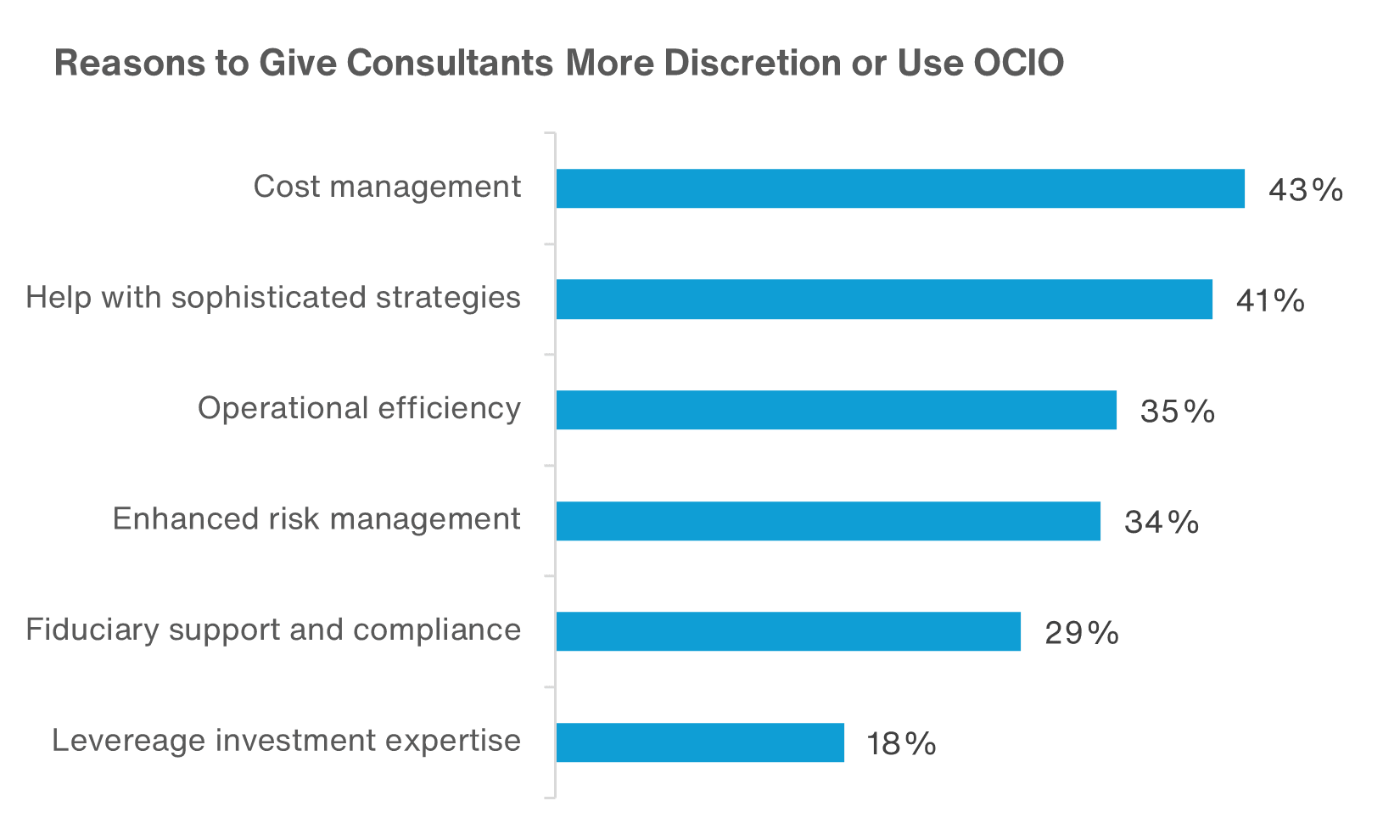
  3. Many Taft-Hartley plans cite cost management and access to sophisticated strategies as primary reasons for OCIO mandates.

The opinions referenced are as of the date of publication and are subject to change due to changes in the market or economic conditions and may not necessarily come to pass. Nothing in this document should be construed as legal, tax or investment advice. Please consult with your independent professional for any such advice.

Taft-Hartley plan trustees have a crucial role in the oversight of plan assets, a role that requires a great deal of expertise, resources, and tools to do prudently. One such tool is the delegation of investment manager selection and execution. A substantial number of Taft-Hartley plans have been discussing the possibility of delegating these tasks to an Outsourced Chief Investment Officer (OCIO). In fact, a survey from Chief Investment Officer found that 50% of union pension plans use an OCIO mandate.1

The goal of using an OCIO is to establish an effective and efficient process for selecting managers and implementing investment portfolios. This model gives the board more time to focus on high-level policy matters, while giving the OCIO the flexibility to make timely decisions in the best interests of the fund’s participants and beneficiaries. However, effective delegation must be accompanied by robust reporting and monitoring frameworks so that the board—the ultimate fiduciary—can fulfill its fiduciary duty to monitor the delegation. This paper provides an overview of how Taft-Hartley plans can examine their situations, and if the decision is made to delegate to an OCIO, how to do so prudently.

Delegation Overview and Best Practices

The duty of prudence not only permits but also expects boards to delegate certain responsibilities. Delegation is a fundamental aspect of sound governance that allows for more efficient and effective decision-making. It involves assigning specific responsibilities to individuals or groups with the expertise to handle them. For Taft-Hartley plan investment committees, this often means delegating certain investment decisions to qualified agents which could be staff and/or an OCIO, while maintaining oversight.

The delegation process should be clearly documented, with well-defined roles and responsibilities, to ensure accountability and transparency. The board’s “sign-off” on the process is crucial, ensuring that all parties understand their duties and the resources available to them. A structured approach helps ensure that delegation enhances, rather than diminishes, the board’s ability to act in the best interests of plan participants and beneficiaries.

50%

A recent survey from Chief Investment Officer found that 50% of union pension plans use an OCIO mandate, underscoring how common OCIO delegation has become among Taft‑Hartley and other labor‑related plans.1

What an OCIO Model Does for Taft-Hartley Plans

At its core, an Outsourced Chief Investment Officer is a discretionary investment model. It lets asset owners such as Taft-Hartley plans hand over day-to-day investment decision-making to a dedicated team of professionals. This includes everything from manager selection and portfolio rebalancing to liquidity management, contracting with managers, and risk oversight.

The asset owner still retains responsibility for setting the investment policy, including key things like strategic asset allocation, rebalancing policy, risk tolerances, etc., while the OCIO implements that investment policy. This model is gaining popularity because the investment landscape has become faster and more complex. Regulatory changes, market volatility, and the proliferation of asset classes have made it harder for internal staff and trustees to keep up.

An OCIO brings scale, strong governance, expertise, access, and agility to help organizations navigate this complexity. Further, because large OCIOs have scale across many asset owners, they are often able to negotiate attractive fees with asset managers that make the all-in fee comparison for OCIO services very competitive.2

Elements of Responsible OCIO Delegation

To ensure prudent delegation, several elements must be in place:

  • Sufficient resources. Both internal and external resources must be understood by the board before it can appropriately delegate. This includes assessing staff capacity, expertise, and operational capability. Regular reviews of these resources are essential to maintain confidence in their effectiveness.
  • Appropriate and clear parameters. The scope of delegation must be explicitly defined. The ultimate approval process and how final decisions are made must be clearly outlined. The board can either fully delegate or set clear parameters, such as asset class limitations and/or portfolio percentage or dollar thresholds for new or existing managers.
  • Robust process for manager selection. Under a delegated model, roles and responsibilities, and the process and procedures for manager selection, must be well-defined to avoid confusion and overlap, and to ensure accountability.
  • Monitoring standards and expectations. When a board delegates, it does not abdicate its responsibility to monitor those who have the delegated responsibility. Defined reporting standards are necessary to fulfill oversight duties. The board must regularly review the delegation process to ensure it remains appropriate. Reporting requirements must clearly define the frequency of updates, level of detail needed, and types of reports required. It is often prudent to have independent reviews of the delegated responsibilities, whether by the board’s investment consultant or another third party.
  • Board action. The board must approve the delegation and monitor it to ensure the delegated action continues to be prudent. The board retains the authority to rescind or change the delegation as it deems necessary.

Benefits and Risks of Delegating to an OCIO

Delegation to an OCIO offers several potential benefits, including fee reductions, more efficient investment decisions, greater use of investment professionals to implement the investment strategy, greater flexibility for those experts, and more time for the board to focus on other priorities such as asset allocation and policy decisions. If implemented correctly, delegation can enhance fiduciary oversight and risk management by holding delegated activities to specific processes and standards, including reporting requirements.

An industry survey asked Taft-Hartley plans using OCIO mandates about the primary reasons they used OCIO mandates, and their responses are in the following exhibit, which highlights cost management and help with sophisticated strategies as the top reasons.3

Enhancing Taft-Hartley Plan Oversight with OCIO Delegation Diagram

However, delegation is not without risk. Reduced participation from the delegating body (board or investment committee) can lead to complacency in oversight and monitoring over time. To mitigate these risks, it is essential to set appropriate parameters and procedures, conduct regular reviews, and ensure transparency and concurrence from all parties involved.

Next Steps for Taft-Hartley Trustees Considering OCIO Delegation

Delegation is a significant decision. For plans interested in exploring potential benefits of delegation, appropriate next steps often include (1) ensuring trustees are conversant with prudent delegation and the current selection process, (2) discussing potential options for delegation, and (3) creating policy and process documents for board review.

By clearly defining roles and responsibilities, setting appropriate parameters, and establishing robust monitoring and reporting requirements, a Taft-Hartley plan can enhance its fiduciary oversight and risk management and seek to improve performance. Regular reviews and transparency are essential to maintaining the effectiveness of the delegation process, ensuring that it continues to align with the plan’s strategic goals and objectives.

Learn more about whether the OCIO model is right for your investment strategy:

Taft-Hartley Plans

If you are evaluating next steps for your Taft Hartley plan—whether traditional investment advisory consulting to partial or full delegation—contact our team for further perspectives tailored to your objectives.

Aon’s Thought Leader
  • PJ Kelly
    Taft-Hartley Solutions Leader, Aon Investments USA Inc.

1 Source: https://www.ai-cio.com/surveys/2025-cio-outsourced-investment-manager-survey/
2 There is no guarantee that results or savings will be achieved if you should select AIUSA and/or its affiliated entities to provide services to you. The experience described does not represent all recommendations made to clients nor does it represent the experience of all clients. The reader should not assume that an investment in any securities identified or a particular recommendation was or will be profitable or favorable.
3 Source: Morgan Stanley

General Disclaimer

Investment advice and consulting services provided by Aon Investments USA Inc. (“AIUSA”). The information contained herein is given as of the date hereof and does not purport to give information as of any other date. The delivery at any time shall not, under any circumstances, create any implication that there has been a change in the information set forth herein since the date hereof or any obligation to update or provide amendments hereto. The opinions referenced are as of the date of publication and are subject to change due to changes in the market or economic conditions and may not necessarily come to pass. Information contained herein is for informational purposes only and should not be considered investment advice. This document is not intended to provide, and shall not be relied upon for, accounting, legal or tax advice or investment recommendations. Any accounting, legal, or taxation position described in this presentation is a general statement and shall only be used as a guide. It does not constitute accounting, legal, and tax advice and is based on AIUSA’s understanding of current laws and interpretation. This document is intended for general information purposes only and should not be construed as advice or opinions on any specific facts or circumstances. The comments in this summary are based upon AIUSA’s preliminary analysis of publicly available information. The content of this document is made available on an “as is” basis, without warranty of any kind. AIUSA disclaims any legal liability to any person or organization for loss or damage caused by or resulting from any reliance placed on that content. AIUSA. reserves all rights to the content of this document. No part of this document may be reproduced, stored, or transmitted by any means without the express written consent of AIUSA. The external sites included in this piece contain[GR5.1] information that has been created, published, maintained, or otherwise posted by institutions or organizations independent of AIUSA. AIUSA does not endorse, approve, certify, or control these websites and does not assume responsibility for the accuracy, completeness, or timeliness of the information located there. Aon Investments USA Inc. is a federally registered investment advisor with the U.S. Securities and Exchange Commission. AIUSA is also registered with the Commodity Futures Trade Commission as a commodity pool operator and a commodity trading advisor, and is a member of the National Futures Association. The AIUSA ADV Form Part 2A disclosure statement is available upon written request to: Aon Investments USA Inc. 200 E. Randolph Street Suite 600 Chicago, IL 60601 ATTN: Aon Investments USA Inc. Compliance Officer

Terms of Use

The contents herein may not be reproduced, reused, reprinted or redistributed without the expressed written consent of Aon, unless otherwise authorized by Aon. To use information contained herein, please write to our team.

More Like This

View All
Talk to Our Team

Let’s Connect

Talk to Our Team

Contact our team today to learn more about how we can help your business.

Contact Us