Navigating Risk Across the Clean Energy Lifecycle from Design to Decommissioning

Navigating Risk Across the Clean Energy Lifecycle from Design to Decommissioning
June 16, 2026 10 mins

Navigating Risk Across the Clean Energy Lifecycle from Design to Decommissioning

Navigating Risk Across the Clean Energy Lifecycle from Design to Decommissioning

Clean energy investment is rising, but so are delivery, performance and financial risks. Scaling wind, solar and storage depends on lifecycle resilience that integrates people, engineering standards and risk transfer from design through long-term operations.

Key Takeaways
  1. Clean energy lifecycle risk accumulates across phases, and fragmented approaches increase disruption, gaps in coverage and capital uncertainty.
  2. Workforce capability, alongside rising natural catastrophe exposure and climate volatility, is increasingly shaping loss severity, insurer confidence and project bankability across the clean energy lifecycle.
  3. A broader approach to loss analysis spanning revenue exposure, valuations and climate risk supports more stable insurance structures and long-term asset performance in clean energy projects.

Clean energy projects are larger, more complex and system-critical than ever. While traditional risks remain, many failures now originate earlier — in design specifications, technology choices and contracting strategies, as well as human capabilities and handover practices that shape performance long before operations begin.

As capital continues shifting toward clean energy, these early decisions help determine whether projects remain insurable, financeable and reliable over decades.

Clean energy lifecycle resilience, linking people, engineering standards and risk transfer from design through operations, has moved from concept to requirement. This shift is redefining how clean energy risk must be understood and managed.

“Resilience is most effective and cost-efficient when built in early, particularly as changing climate patterns and more frequent natural catastrophes increasingly shape long-term performance and value,” says Helen West, Natural Resources Leader, Canada (Central & East).

Global Clean Energy Investment vs. Fossil Fuel Investment

The increase in clean energy investment and decrease in fossil fuel investment reflect a structural shift in capital allocation toward energy transition and heightened energy transition risk.

  • 70%

    Global clean energy investment has increased by nearly 70% over the past decade.

    Source: World Energy Investment 2025, International Energy Agency, Statista

  • 20%

    Fossil fuel investment has fallen by around 20%.

    Source: World Energy Investment 2025, International Energy Agency, Statista

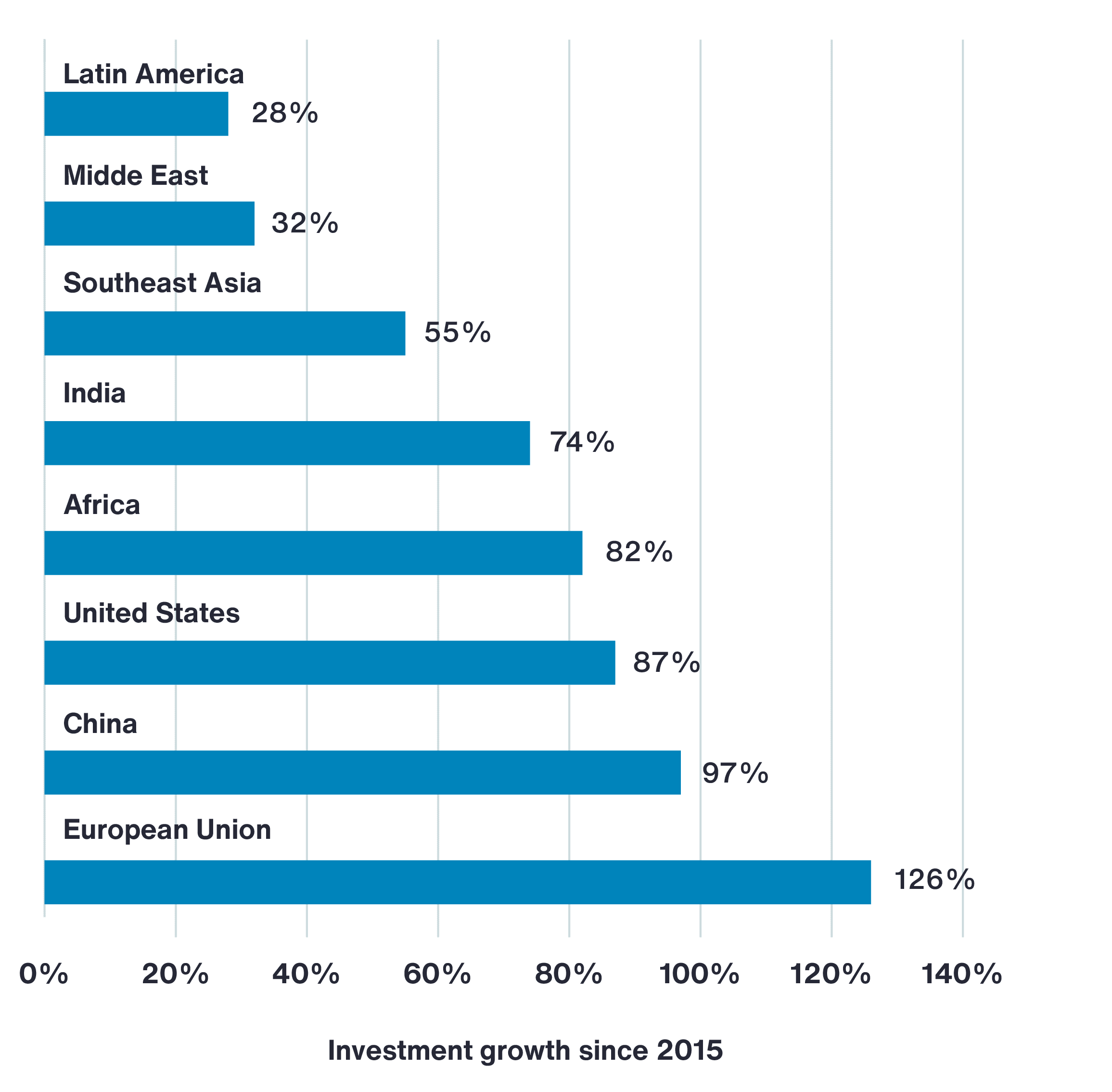
Percentage Change in Clean Energy Investments Worldwide (2015 to 2025)

Over the past decade, clean energy investment grew fastest in the European Union (+126%), with China close behind (+97%), highlighting sustained momentum across major clean energy markets.

Source: International Energy Agency, Statista

Managing Risk Across the Clean Energy Lifecycle Chart 1
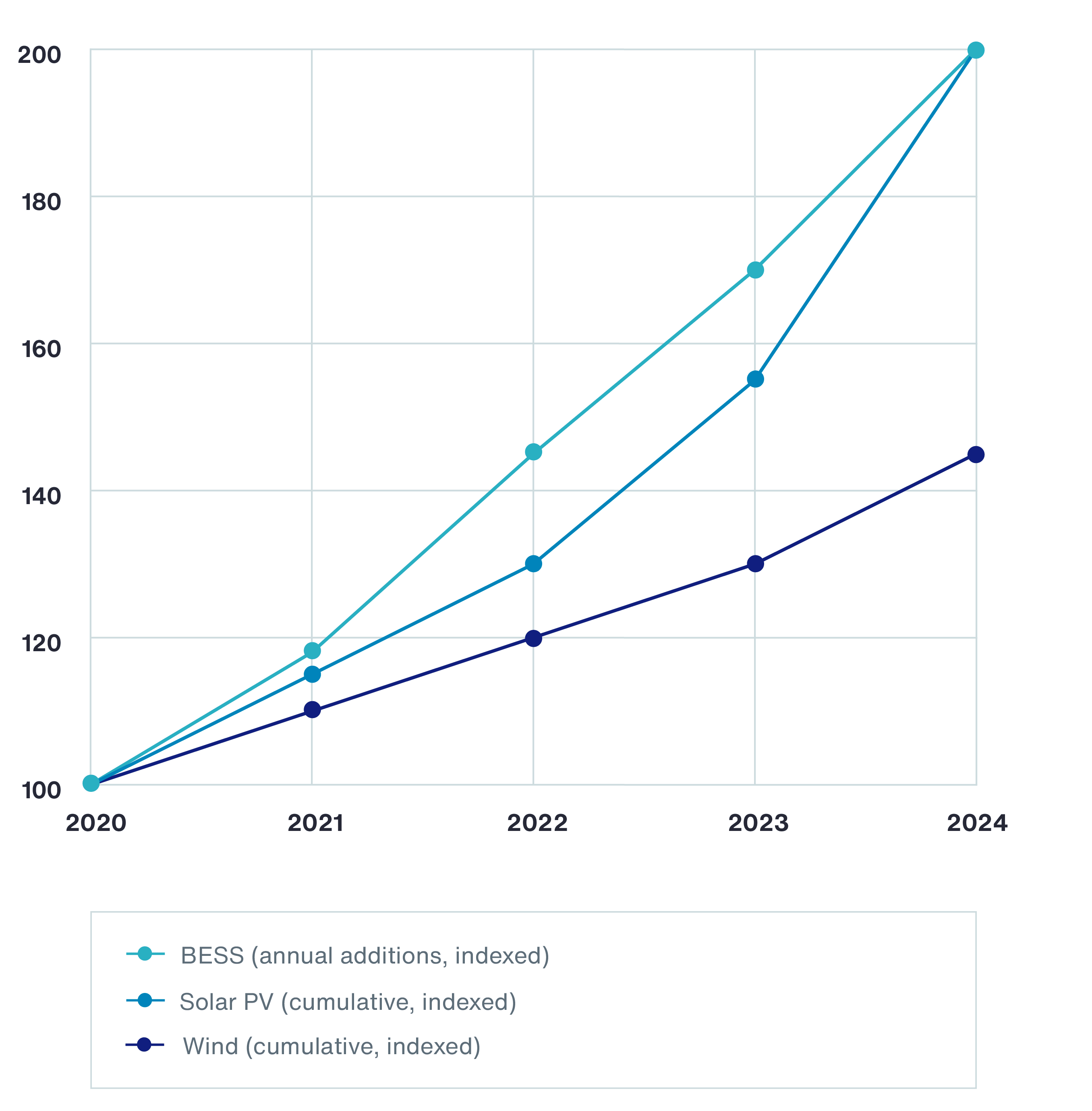
Clean Energy Scaling Trajectories (2020 – 2024)

The indexed trends show battery storage scaling much faster than solar and wind, while solar has accelerated ahead of wind since 2020. The uneven growth underscores that clean energy risk is no longer about whether assets will scale, but how quickly different technologies become system‑critical, reinforcing the need for robust clean energy lifecycle risk management.

Source: SolarPower Europe, GWEC, EY; Rystad Energy; IEA, Statista

Managing Risk Across the Clean Energy Lifecycle Chart 2

Why Fragmented Risk Management Fails at Scale

Risk management approaches have not always kept pace with increasing project complexity.

Clean energy projects are often accelerated to meet subsidy windows, auction timelines or offtake commitments. Risk ownership correspondingly shifts across lifecycle phases, ranging from developers, engineering, procurement and construction contractors, and original equipment manufacturers during construction, to operators and asset managers post-commissioning.

This fragmentation, driven by shifting risk ownership across lifecycle phases, creates a structural disconnect. The most material exposure is not information loss alone, but inconsistency in coverage and risk assumptions across phases. Misalignment between construction and operational insurance, particularly during phased commissioning, can create critical protection gaps as assets begin generating revenue.

These gaps often translate directly into insurance inefficiencies and capital uncertainty, contributing to persistently volatile delivery outcomes. More than 60% of energy infrastructure projects exceed budget, with average cost overruns of around 40% and delays approaching two years.1

Late engagement with risk advisors and brokers further compounds these issues, often resulting in:

  • Design features that are difficult or costly to insure
  • Coverage exclusions or reduced capacity for key risks such as fire, explosion and business interruption
  • Increased lender scrutiny or delays to financial close

The pressure is most acute in:

  • Wind (onshore and offshore), as turbine scale and complexity increase
  • Utility-scale solar projects
  • Battery energy storage systems (BESS), particularly co-located assets

Meanwhile, underwriting appetite remains constrained for higher-risk projects as climate-driven losses, asset concentration and technical complexity increase even as the overall market expands.2

These constraints reflect a deeper structural issue: Risk is still being managed in silos, even as projects become more complex and interconnected.

Addressing this requires a shift to a continuous lifecycle approach. Organizations should work to integrate people, engineering and risk transfer into a single strategy, rather than treating them as separate decisions. The implications are most visible in how projects are designed and delivered, and in how lifecycle risk management supports project bankability.

190%

The renewable energy insurance market is projected to expand by nearly 190% over the next decade, reflecting rising asset values, climate driven loss exposure and increasing demand for integrated risk engineering and specialist coverage.

Source: Renewable Energy Insurance Market Size & Share 2025 – 2034, Global Market Insights

Quote icon

Projects will still move forward, but many are proceeding with constrained insurance capacity and longer-term performance risk increasingly baked into their economics.

Jon Wiegand
Head of Power, Power Management, Europe, the Middle East and Africa

People and Risk Culture as the First Design Decision

When risk accumulates across the lifecycle, it begins with people. Talent and risk culture drive project performance from installation through to long-term performance.

Installation integrity, commissioning quality and early-life reliability are directly linked to workforce capability. Yet, clean energy expansion continues to outpace the supply of experienced talent. Around 60% of energy companies report labor shortages that affect timelines, system reliability and cost control.3

These constraints are most visible in:

  • Project and delivery leadership, where capability gaps affect execution discipline and decision quality
  • Design teams navigating emerging technologies and insurability requirements
  • Operations and maintenance functions responsible for sustaining long-term asset performance

At the same time, competition for contractors across infrastructure sectors is intensifying execution risk.

Workforce constraints are no longer operational challenges. They are core risk drivers influencing project delivery, loss outcomes and insurer confidence across the clean energy lifecycle.

Leading organizations are responding by:

  • Embedding risk and safety expertise directly into project teams
  • Treating workforce capability as a formal risk input within project design and governance
  • Aligning training, incentives and insurance expectations early in the lifecycle.

“From an underwriting perspective, human factors are a critical predictor of loss severity,” explains Tracey Erwin, National Energy Practice Leader, North America. “Well-trained teams and disciplined operations build insurer confidence before claims performance ever shows up.”

Engineering Standards That Make Risk Insurable

Even the most capable teams cannot manage risk without clear, consistent engineering frameworks.

As clean energy technologies scale, they introduce distinct and evolving risk profiles:

  • BESS systems bring fire propagation and thermal runaway risks.
  • Hydrogen introduces leakage, combustion and material integrity challenges.
  • Wind turbine scale continues to increase both exposure severity and failure complexity.

“Technology is evolving so rapidly that obsolescence and replacement costs must be factored into risk profiles from the outset,” says Alison Clarke, Renewables Leader, United Kingdom.

For insurers, the challenge is not simply the presence of risk. It is uncertainty around how that risk plays out.

When engineering approaches lack consistency or clear benchmarks, insurers cannot reliably quantify maximum foreseeable loss, price risk accurately or deploy capacity effectively. This often leads to reduced coverage, higher costs or constrained insurability.

This is where engineering-led standards become a critical bridge. By establishing clear, repeatable benchmarks — from fire protection design to large-scale turbine specifications — organizations reduce uncertainty and create more predictable risk profiles. This supports stable insurance structures and stronger capital confidence in clean energy projects.

“In clean energy, risk engineering is what turns innovation into something insurers can stand behind,” explains Ross Murphy, National Director for Natural Resources, Canada. “It’s an enabler of progress.”

Linking Design Decisions to Long-Term Performance

Resilience delivers the greatest value when built in at the design stage, not retrofitted later. Yet many projects still prioritize near-term construction pressures over long-term operational outcomes.

A lifecycle-resilient approach embeds long-term performance, insurability and reliability into early decisions. In practice, this means:

  • Designing with long-term operating conditions and evolving risk profiles
  • Maintaining continuity of data and insights from construction through operations
  • Aligning stakeholders around a shared, lifecycle risk baseline

This continuity is critical as projects transition into operations. Construction-phase data, including commissioning quality and system performance, directly informs operational insurance structures and loss control strategies.

The objective is not to reduce risk, but to ensure that it is understood, aligned and managed consistently over time. This consistency is what makes risk transferable and investable. It enables insurance to support both capital deployment and long-term performance, rather than responding to issues after they emerge.

Risk Transfer as a Catalyst for Investment

When aligned early with engineering and lifecycle planning, insurance becomes a strategic enabler rather than a constraint. It supports:

  • Lender confidence and financing certainty
  • Rapid liquidity following loss events
  • Portfolio-level volatility management

Solutions gaining traction include:

  • Integrated construction-to-operations insurance programs that maintain continuity of coverage as assets transition into revenue generation
  • Parametric coverage that provides faster, more predictable responses to weather-related risks
  • Portfolio and captive structures that support diversification and more efficient capital deployment
Quote icon

When aligned early with engineering and lifecycle planning, insurance shifts from a constraint to a strategic enabler. Integrated risk engineering and insurance strengthen resilience, improving insurability and supporting bankable outcomes.

Patrick Behan
Head of Energy Transition for Power & Renewables, Australia

Designing Energy That Endures

The success of clean energy projects will be determined by how effectively risk is managed as scale increases. Risk will remain elevated as technologies evolve and systems become more interconnected. The difference is not whether challenges emerge, but how prepared projects are to manage them from the outset.

Projects that embed resilience early and apply it consistently are more likely to deliver predictable performance, maintain insurability and secure capital in a more selective market.

Lifecycle resilience strengthens performance and capital discipline. It reduces volatility in delivery and operations, supports more consistent underwriting and enables more efficient access to capital. It also allows organizations to scale more reliably by replicating proven approaches across portfolios.

As Rebecca McCabe, Power & Renewables Practice Leader, United States, simply states, “Building resilience across the clean energy lifecycle is no longer optional. It is central to a successful energy transition.”

Explore how integrated insurance and risk strategies can strengthen resilience across the clean energy lifecycle. Learn more about Aon’s energy transition and energy risk capabilities.

Aon’s Thought Leaders

Patrick Behan
Head of Energy Transition, Power & Renewables, Australia

Alison Clarke
Renewables Leader, United Kingdom

Tracey Erwin
National Energy Practice Leader, North America

Rebecca McCabe
Power & Renewables Practice Leader, United States

Ross Murphy
National Director, Natural Resources, Canada

Helen West
Natural Resources Leader, Canada (Central & East)

Jon Wiegand
Head of Power, Power Management, Europe, the Middle East & Africa

General Disclaimer

This document is not intended to address any specific situation or to provide legal, regulatory, financial, or other advice. While care has been taken in the production of this document, Aon does not warrant, represent or guarantee the accuracy, adequacy, completeness or fitness for any purpose of the document or any part of it and can accept no liability for any loss incurred in any way by any person who may rely on it. Any recipient shall be responsible for the use to which it puts this document. This document has been compiled using information available to us up to its date of publication and is subject to any qualifications made in the document.

Terms of Use

The contents herein may not be reproduced, reused, reprinted or redistributed without the expressed written consent of Aon, unless otherwise authorized by Aon. To use information contained herein, please write to our team.

More Like This

View All
  • AI Isn’t the Differentiator. Workforce Readiness Is

    Article 11 mins

    AI Isn’t the Differentiator. Workforce Readiness Is

    AI is rapidly reshaping how work gets done and where value is created, yet many organizations are not translating their investment into business outcomes. Closing the gap between deployment and impact requires a focus on workforce readiness and aligning people strategy to performance.

  • Why Third Party Cyber Risk is a Balance Sheet Issue

    Article 8 mins

    Why Third-Party Cyber Risk is a Balance Sheet Issue

    Many organizations assume contracts or insurance transfer third-party cyber risk until a disruption proves otherwise. Limiting financial fallout requires treating third-party exposure as a capital and resilience issue, with direct implications for earnings, cash flow and balance sheets.

  • Aon 2025/26 Global Pension Risk Survey

    Article 4 mins

    Aon 2025/26 Global Pension Risk Survey

    Explore how pension sponsors and leaders are responding to investment volatility, the latest regulations and operational pressures in Aon’s 2025–26 Global Pension Risk Survey.

Subscribe CTA Banner