Why Third-Party Cyber Risk is a Balance Sheet Issue

Why Third-Party Cyber Risk is a Balance Sheet Issue
June 15, 2026 8 mins

Why Third-Party Cyber Risk is a Balance Sheet Issue

Why Third Party Cyber Risk is a Balance Sheet Issue

Many organizations assume contracts or insurance transfer third-party cyber risk until a disruption proves otherwise. Limiting financial fallout requires treating third-party exposure as a capital and resilience issue, with direct implications for earnings, cash flow and balance sheets.

Key Takeaways
  1. A third-party cyber incident can severely disrupt operations and expose gaps in insurance coverage, creating material financial impact.
  2. Contract value doesn’t always reflect true risk. Smaller suppliers can drive outsized losses when exposure is not fully understood.
  3. Effective cyber risk management means quantifying financial impact from third-party incidents to inform the appropriate risk mitigation, transfer and retention strategies.

A single vendor outage can halt operations and disrupt core business activities. Yet, many boards continue to assume that contracts and insurance will absorb most third-party cyber exposure. 

At the same time, organizations often overestimate both the scope of contingent business interruption coverage, and the extent to which cyber and privacy risk is transferred to third parties.  

In practice, recoveries can be constrained by policy design and evidentiary requirements. Common limitations include:

  • Narrow definitions of covered service providers 
  • Requirements to prove a vendor’s security failure 
  • Exclusions related to infrastructure or shared systems  
  • Reduced sublimits for dependent business interruption 

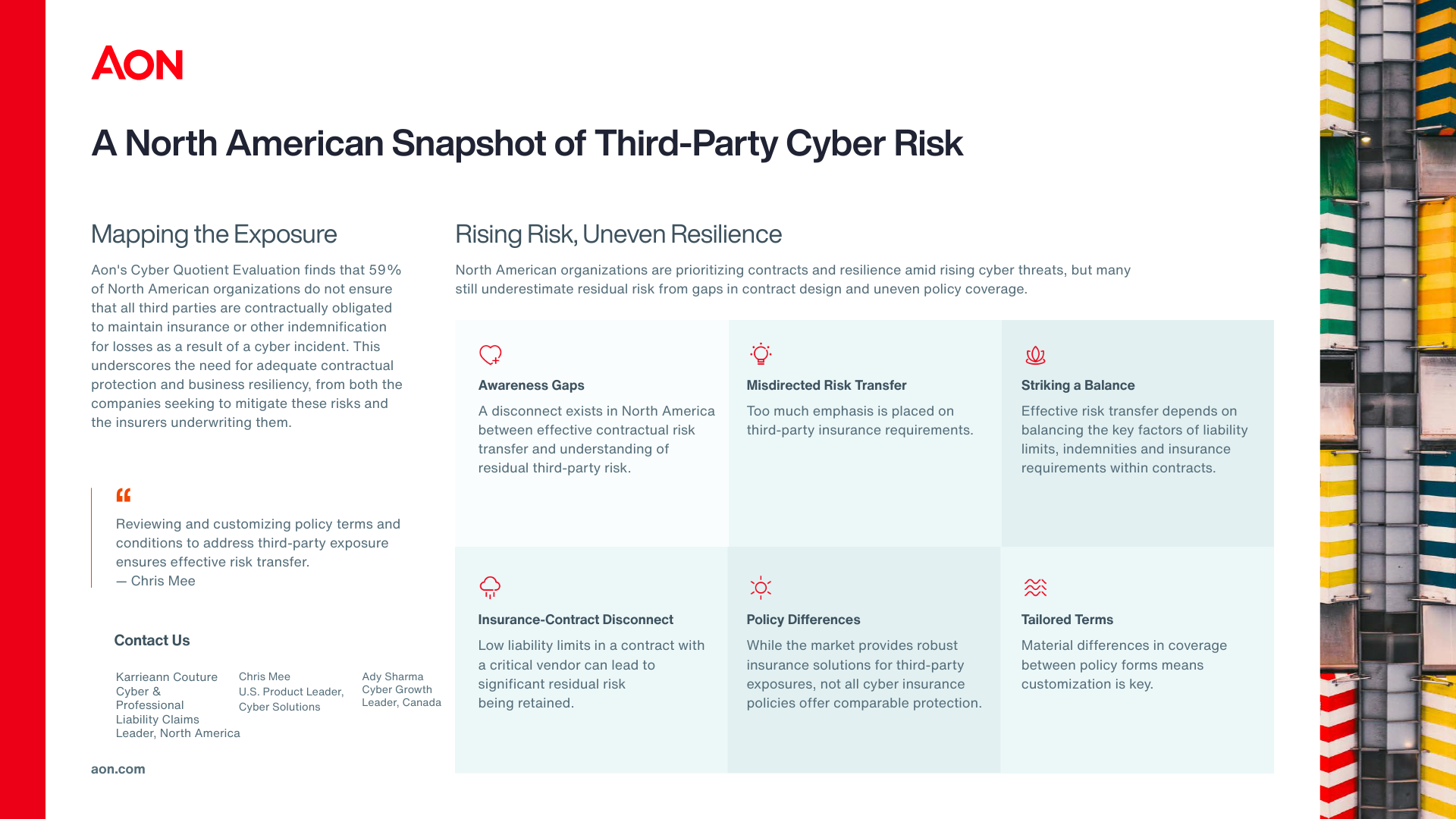
Even when an incident originates in a vendor’s environment, liability might not fully transfer. “Regulators, consumers and other claimants often pursue the organization that collected the data, owns the customer relationship or chose to engage the vendor,” explains Karrieann Couture, Aon’s Cyber and Professional Liability Claims Leader, North America. 

However, third-party cyber risk is financially quantifiable and, in part, insurable. The key is managing it effectively. This demands clear ownership at the board level and coordinated ownership across cyber, procurement, legal and finance, with accountability for how risk is measured and managed. 

Senior leaders need to understand when insurance does and does not respond, while also ensuring contract design supports this position. This requires integrating risk quantification, insurance strategy and contractual protections, rather than managing them in isolation.

The most successful organizations make explicit, evidence-based decisions on the balance between risk mitigation, transfer and retention. These trade-offs should be grounded in quantified exposure and aligned to risk appetite, capital priorities and operational resilience objectives. 

9

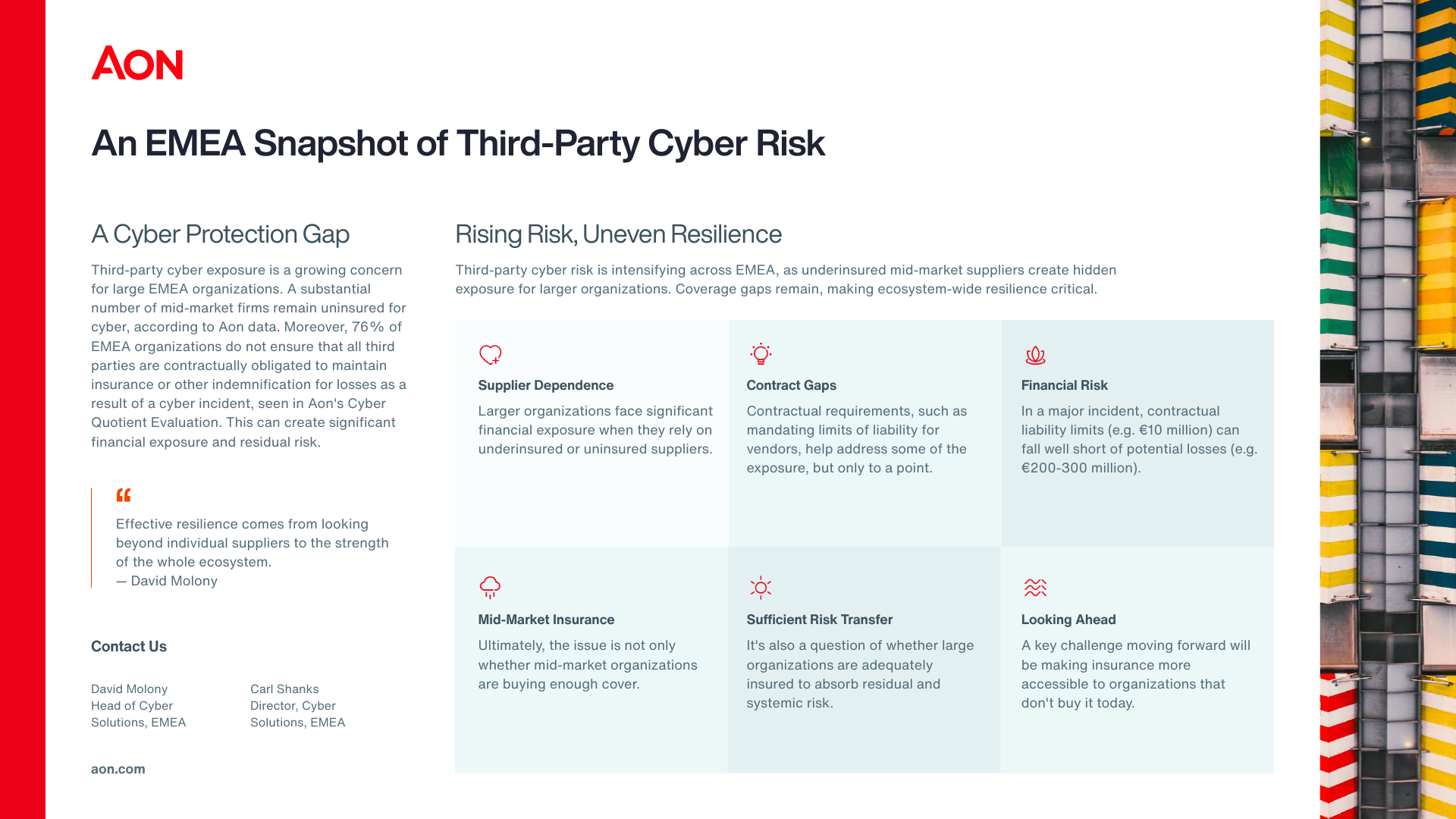
When organizations are assessed across nine key cyber security measures, third-party controls receive the lowest average scores. The most notable third-party gaps are in due diligence and contracting.

Source: Aon’s Cyber Quotient Evaluation

Quote icon

Volatility isn’t a moment in time anymore — it’s the environment in which we operate. That’s why third-party cyber risk management must continuously evolve, with leaders balancing protection, controls and insurance rather than making either/or investment decisions.

David Molony
Head of Cyber Solutions, Europe, the Middle East and Africa

What Does Third-Party Cyber Risk Look Like? 

Third-party cyber events can involve both: 

  • Technology Vendors

    Organizations often rely on vendors to support core systems and manage sensitive data. When these platforms are compromised or experience outages, the impact to operations and resulting liability can be significant. 

    Potential Scenario: A marketing automation vendor is compromised, allowing a cyber attacker to distribute branded emails with phishing links. The organization must notify affected customers, suspend vendor access, secure accounts and investigate the extent of data exposure. These actions drive direct costs and can disrupt revenue, cash flow and reputation.

  • Non-Technology Vendors

    Cyber risk is also expanding beyond traditional IT providers. Digitization, more sophisticated threat actors and reliance on just-in-time delivery models have increased the vulnerability of operational and supply chain partners. 

    Potential Scenario: A logistics provider relies on a digital freight platform to manage shipments. A cyber criminal gains access using spoofed credentials and impersonates a verified carrier. The shipment is released, but never reaches the end retailer, leading to financial loss, operational disruption and liability disputes across multiple parties. 

Fourth-Party Cyber Risk: An Exposure Multiplier

As vendor platforms underpin a growing number of organizations, the scale of cyber risk increases. This trend is accelerating as more business operations migrate to the cloud, concentrating exposure in a small number of shared providers. 

These shared platform dependencies shift third-party cyber losses from isolated, independent breaches to correlated, system-wide events. A common provider or software failure can trigger large numbers of simultaneous claims, eroding risk diversification and complicating causation and loss allocation. The CrowdStrike outage was one example, when a failed software update created widespread disruption, alongside other notable, industry-specific incidents.

As digital infrastructure expands, visibility into direct suppliers alone is no longer enough. Organizations should identify their deeper vendor dependency chains and where concentrated exposure could result in material financial loss.

Quote icon

Some of the most challenging third-party events are not traditional cyber attacks, but systemic outages, non-malicious events and technology failures that complicate how insurance coverage should respond.

Karrieann Couture
Cyber and Professional Liability Claims Leader, North America

4 Gaps Increasing Third-Party Cyber Exposure

  • 02

    Lagging Cyber Maturity

    Critical vendors may lack the necessary resources, expertise or investment to defend against evolving cyber threats.

  • 04

    System Gray Zones

    Gaps between IT and OT systems create unmonitored entry points, with attacks increasingly originating in less secure OT networks.

The Contract-Insurance Disconnect 

Organizations need a clear view of the financial exposure from third-party cyber risks to ensure insurance coverage and contracts reflect the risk accurately.  

Traditional approaches frequently rely on contract value or bill-of-materials cost to prioritize vendors and set insurance limits.  

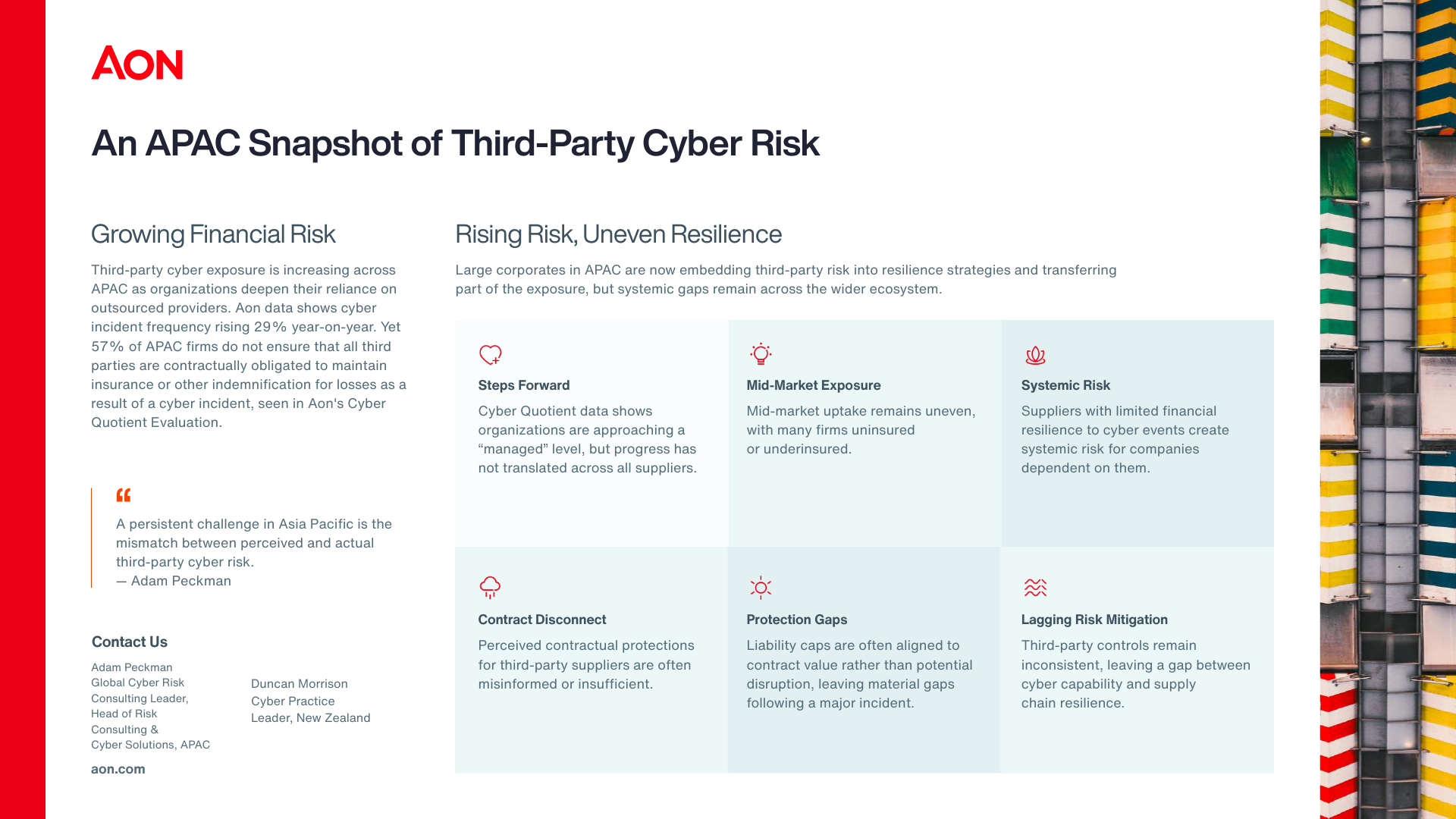
“Third-party risks might be prioritized by biggest to smallest contract size and insurance limits can be decided by a percent of contract value,” explains Adam Peckman, Aon’s Global Cyber Risk Consulting Leader and Head of Risk Consulting & Cyber Solutions, Asia Pacific. “But in today’s digital and cyber context, there can be an asymmetric relationship between the contract or service value of a third party and the financial risk they pose to an organization.” 

A vendor with access to sensitive data (e.g., personally identifiable information or intellectual property) or responsibility for mission-critical technology can cause exposure that far exceeds the value of the services they provide. This creates a disconnect between perceived and actual risk. 

Quantifying third-party cyber risks can reveal where these mismatches and systemic issues exist, and calibrate contract and insurance strategies accordingly.

3 Strategies to Make Third-Party Cyber Risk Decisions Explicit and Defensible 

Managing third‑party cyber risk effectively starts with answering the right questions. Leaders need to identify where risk should be mitigated, transferred or retained based on quantified exposure and business impact.

  1. Quantify the Risk
    Risk quantification provides a holistic view across the supply chain. Organizations should assess suppliers using consistent risk scoring, then tier them based on potential loss and operational criticality.
  2. Use Data to Inform Decisions
    Supply chain visibility tools and data should inform both insurance design and security investment strategy. This enables organizations to align coverage controls and capital allocation with where exposure is most concentrated.
  3. Continuously Reassess Exposure
    Third-party cyber risk evolves as business models and threat landscapes change. Regular risk reviews with a broker can help boards ensure coverage and protections remain aligned with current exposures. This approach also helps organizations respond to market developments (e.g., supply chain disruption, failure to supply, licensing risk and customer extension).

How Aon Helps Turn Third-Party Cyber Risk into Measurable, Managed Exposure 

By integrating Aon’s cyber risk insights with contracts and insurance design, organizations can pinpoint hidden exposures, avoid risk aggregation and protect their balance sheets. 

“We’re helping organizations monitor and tier their supply chains so they understand contractual liability limits and insurance requirements,” says David Molony, Aon’s Head of Cyber Solutions, Europe, the Middle East and Africa. “And we're reinforcing the broader value of cyber insurance across the ecosystem.” 

Contact our team to start taking a more strategic, end-to-end approach to third-party cyber risk

Aon’s Thought Leaders 

Karrieann Couture 
Cyber and Professional Liability Claims Leader, North America 

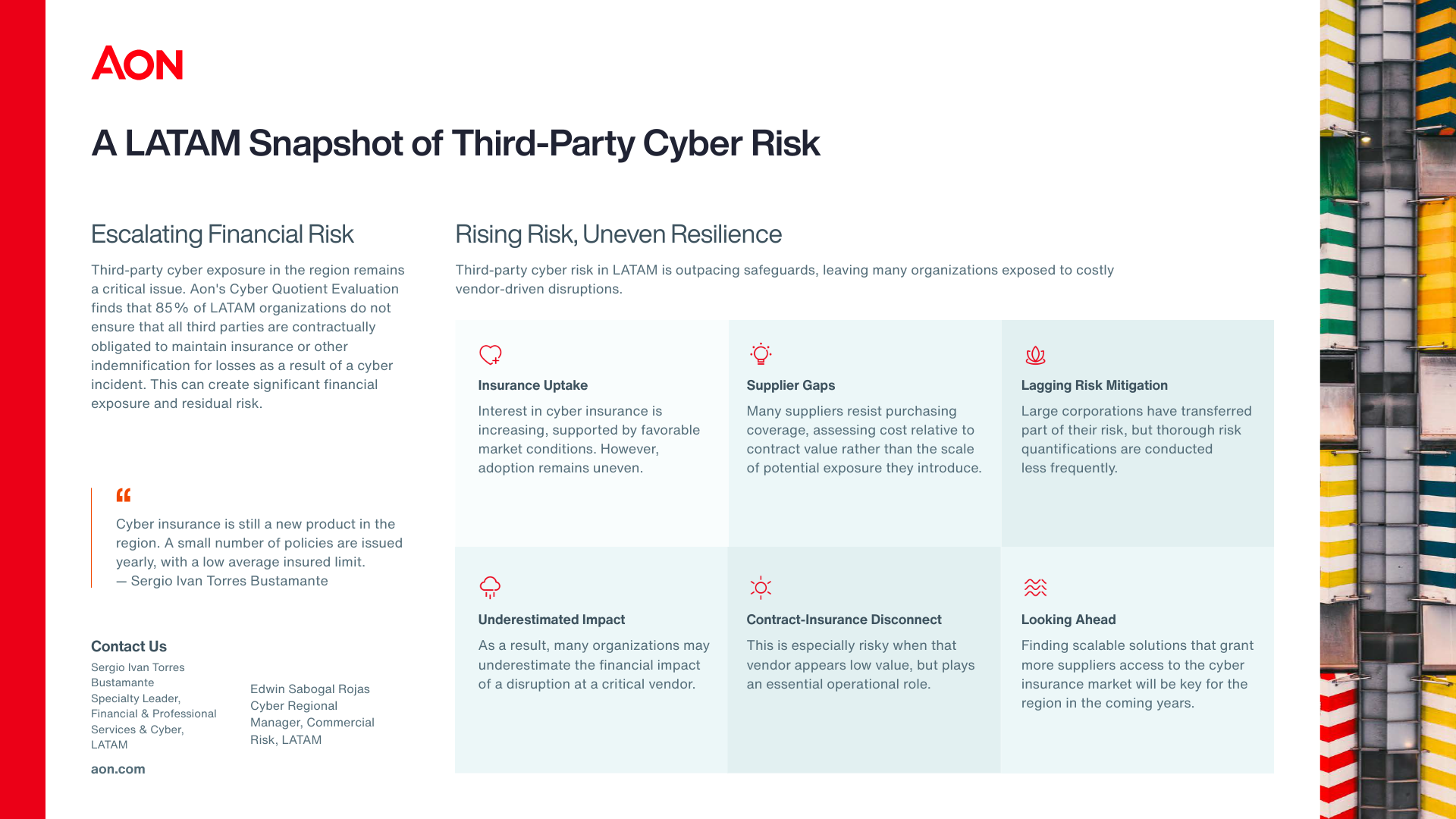
Sergio Ivan Torres Bustamante 
Specialty Leader, Financial & Professional Services & Cyber, Latin America 

Chris Mee 
Product Leader, Cyber Solutions, United States 

David Molony 
Head of Cyber Solutions, Europe, the Middle East and Africa 

Duncan Morrison 
Cyber Practice Leader, New Zealand 

Adam Peckman 
Global Cyber Risk Consulting Leader, Head of Risk Consulting & Cyber Solutions, Asia Pacific 

Edwin Sabogal Rojas 
Cyber Regional Manager, Commercial Risk Solutions, Latin America 

Carl Shanks 
Director, Cyber Solutions, Europe, the Middle East and Africa 

Ady Sharma 
Cyber Growth Leader, Canada

General Disclaimer

This document is not intended to address any specific situation or to provide legal, regulatory, financial, or other advice. While care has been taken in the production of this document, Aon does not warrant, represent or guarantee the accuracy, adequacy, completeness or fitness for any purpose of the document or any part of it and can accept no liability for any loss incurred in any way by any person who may rely on it. Any recipient shall be responsible for the use to which it puts this document. This document has been compiled using information available to us up to its date of publication and is subject to any qualifications made in the document.

Terms of Use

The contents herein may not be reproduced, reused, reprinted or redistributed without the expressed written consent of Aon, unless otherwise authorized by Aon. To use information contained herein, please write to our team.

More Like This

View All
  • Aon 2025/26 Global Pension Risk Survey

    Article 4 mins

    Aon 2025/26 Global Pension Risk Survey

    Explore how pension sponsors and leaders are responding to investment volatility, the latest regulations and operational pressures in Aon’s 2025–26 Global Pension Risk Survey.

  • Four Considerations for Evolving Work with AI

    Article 5 mins

    Four Considerations for Evolving Work with AI

    Many companies face pressure to shrink workforces, but people‑first strategies can realize AI’s value while preserving strength and talent. Explore workforce design that empowers employees and unlocks the full value of AI.

Subscribe CTA Banner