Securing Power: Global Strategies for Data Center Energy Resilience

Securing Power: Global Strategies for Data Center Energy Resilience
October 20, 2025 13 mins

Securing Power: Global Strategies for Data Center Energy Resilience

Securing Power: Global Strategies for Data Center Energy Resilience

Artificial intelligence is driving unprecedented demand for data center power, straining global grid capacity and reshaping energy strategies. Developers are racing to secure reliable energy but face complex risks and challenges.

Key Takeaways
  1. Data center energy demand is forecast to nearly triple by 2030, intensifying competition for limited power resources.
  2. Securing grid access and alternative energy sources is now a strategic priority for developers and investors.
  3. Working with a broker that specializes in data center risk management is essential to navigate power constraints, mitigate exposures and support growth.

Artificial intelligence (AI) is quickly becoming an integral part of life, revolutionizing how we live and work, creating new efficiencies and delivering new discoveries. It’s also significantly increasing global energy demand, with AI data centers set to account for a substantial share.

Without energy, AI doesn’t exist. However, data centers are already taxing grid capacity, with demand expected to nearly triple in coming years. Gaining access to power will be a growing challenge for data center developers.

Securing Power: Global Strategies for Data Center Energy Resilience

AI’s rapid growth also comes with growing risk concerns among global risk and business leaders, ascending to one of the top future risks in Aon’s 2025 Global Risk Management Survey.

“We’re dealing with a slow-moving insurance industry trying to keep pace with fast-moving technology and rapidly evolving needs,” says Brian Hearst, Managing Director, Data Center & Life Sciences Builders Risk Leader for Aon in North America. “The convergence of these forces is creating a complex and unpredictable environment.”

Regional Energy Impacts

Regional Energy Impacts

In the UK, grid capacity is struggling to keep pace with demand, with data centers expected to consume nearly as much power by 2050 as the entire UK industrial sector does today.1

In the U.S., data centers consumed 4.4% of electricity, a number that could triple by 2028.2

Asia Pacific currently captures roughly 30% of global data center capacity and is expected to grow at a CAGR of 21% by 2028, led by China, Japan, India, Australia, Singapore, South Korea and Hong Kong, which account for 90% of the region’s capacity.3

Growing Challenges for Developers

According to the World Economic Forum (WEF), there were 11,800 data centers worldwide as of April 2025, with nearly half of them (5,381) in the U.S.4 The WEF expects that to shift as other markets, including India, Brazil, Kenya, the UAE and Singapore, increase data center investments to position themselves as regional hubs.

The mismatch between fast-moving technology demands (AI, edge computing, etc.) vs. slow-moving infrastructure development cycles is a systemic risk.

Today, the first and most critical question of developers is “can we get power?” Access to a robust, scalable and readily available energy source has become the ultimate gating factor.

220GW

AI workload is forecast to drive data center energy demand, from 82 gigawatts (GW) in 2025 to 220 GW in 2030.

Source: Statista

Addressing Power Generation Delays Globally

As demand accelerates, power generation delays are impacting project timelines, financing and insurability. Global challenges in securing reliable power are prompting significant reforms, including:

UK: National Grid’s “First Ready, First Connected” (FRFC) reforms prioritize green energy projects that are both ready and needed, replacing the previous first come, first served model. Reform aims to accelerate the connection of viable clean energy projects, reduce delays and support the UK’s 2030 clean power mission.5 These efforts will help in areas such as West London, where severe electricity grid capacity constraints, driven by data center development, are delaying housing projects.6

U.S.: The PJM Interconnection (PJM), which coordinates the movement of electricity through all or parts of 13 states and the District of Columbia,7 faces significant interconnection delays due to an overloaded interconnection queue for new generation projects and market reform challenges. This backlog has caused significant project delays, inflated electricity costs and hindered reliability, prompting regulators to approve delays in capacity auctions while new market rules are developed.

Asia Pacific: In both Tokyo and Singapore, "grid saturation" is a growing challenge stemming from the rapid increase of intermittent renewable energy sources, especially solar.

Quote icon

Everyone’s racing to build, but few are asking whether it’s realistic, do we have the steel, water, labor and the supply chain to support this scale? These are critical questions that need answers.

Alison Clarke
Renewables Leader, United Kingdom

Key Constraints on Power Access

Growth of data centers continues to create additional common challenges for developers, including:

  • Permitting delays

    Securing zoning and land-use approvals is often time-consuming, leading to construction delays, penalties and limited energy options.

    Regulatory and planning constraints vary by region, but risk leaders consistently identify permitting as a top concern and an emerging future risk, according to Aon’s 2025 Global Risk Management Survey.

    “In the U.S. it can take a fairly long time, at least three years, to get a grid connection,” says Carol Stark, Renewable Energy Leader for Aon in North America. “Permitting under the current administration could get a little easier for traditional power generation because they appear to be relaxing some of the rules, but we have not seen that yet.”

    Adds Clarke: “It is the same situation in Europe, with roughly the same time delays getting into the grid. While some governments are trying to improve on that process it is still taking 12 to 24 months.”

  • Grid congestion

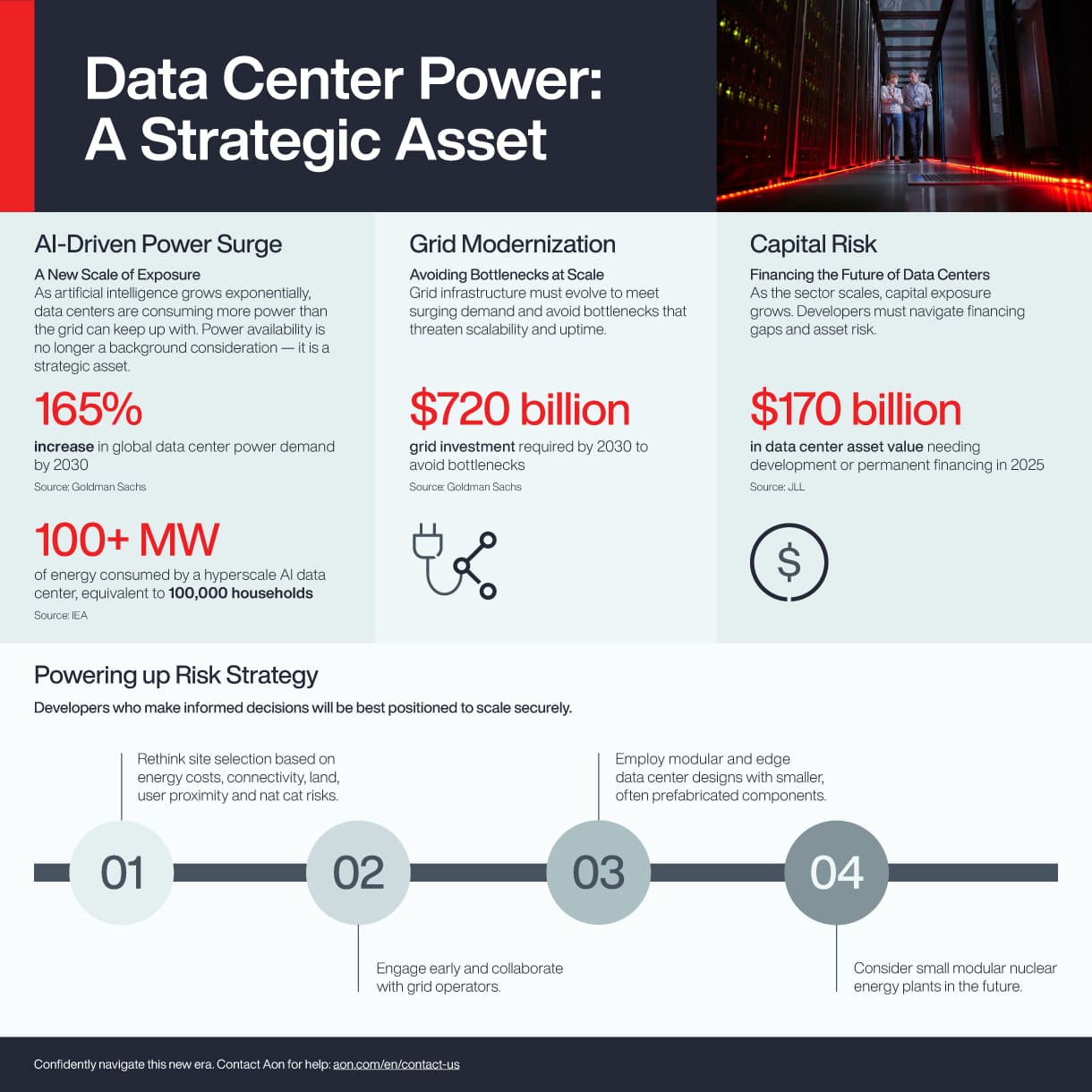
    Conventional data centers are roughly around 10-25 megawatts (MW) in size. However, a hyperscale, AI-focused data center could have a capacity of 100 MW or much more — equivalent to the annual energy consumption of 100,000+ households.8 An increase of this magnitude clearly places strain on local grids.

  • Aging infrastructure

    An aging, albeit maintained, global grid infrastructure, combined with skyrocketing data center demand, presents both challenges and new opportunities for data center contractors.

  • Queue backlogs

    Project delays, increased costs and reputational damage often stem from overloaded interconnection queues and global supply chains bottlenecks for critical equipment.

  • Sustainability targets

    Data centers have vast sustainability impacts, from energy and water to land use. Developers must address these or risk delays, cost increases and penalties.

  • Water rights and zoning restrictions

    Planning frameworks must now account for water sourcing, especially in drought-prone regions or underground reservoir dependencies. Zoning laws may restrict access to water or prohibit desalination infrastructure.

  • Speculative development risks

    Applying for grid connections in multiple locations can lead to planning inefficiencies and stranded asset risks if anticipated demand doesn’t materialize. “Speculative grid applications can lead to planning inefficiencies and stranded asset risks,” says Brian DeBruin, Managing Director, Natural Resources/Power & Renewables for Aon in the United States. “Utilities may invest in infrastructure based on anticipated demand that never materializes, complicating regulatory approvals and long-term planning.”

Finding Solutions: How Developers are Responding to Power Constraints

Exploration of Alternative Power Models and Innovation

Data centers cannot afford power disruptions — they require firm, consistent energy. Developers are exploring a range of alternative power strategies to reduce reliance on constrained grid infrastructure and improve energy resilience.

“We are seeing a lot of companies doing this, moving from an independent power producer to their own facility because they don’t want to be reliant on the grid,” adds Stark.

Alternative power strategies currently in the mix include both short-term bridging solutions and longer-term innovations:

On-site generation: accelerates deployment and provides greater control and stability over energy supply. Common approaches include:

  • Natural gas units offer interim baseload support and rapid response, though they raise concerns about emissions.
  • Solar combined with battery storage supports peak shaving and sustainability, reducing costs and enhancing grid resilience.

Small Modular Reactors (SMR): considered for long-term baseload. SMRs offer continuous, low-carbon energy with a smaller footprint and modular scalability.9 Some U.S.-based data center operators have already signed early-stage agreements with SMR developers, but commercial deployment faces regulatory, cost and supply chain hurdles, with initial commercial projects not expected until the early 2030s.

Energy co-locating: siting data centers near existing or planned power generation facilities, often sharing grid connection to reduce costs, gain efficiencies and integrate renewable energy sources.

Geothermal systems: in geologically suitable locations, offers stable, carbon-free power and direct cooling solutions for high, continuous energy demands.

AI-enhanced forecasting and demand shaping: help operators better align energy supply with demand, particularly when integrating intermittent renewables.

Securing Confidence: Solutions that Address Developer Risk Concerns

Alternative power models reflect a broader move toward more diversified and resilient energy strategies, with power planning increasingly embedded in early-stage data center design.

However, they also introduce new risk profiles for developers, which require tailored insurance programs. A broker with data center developer expertise can advise on construction risk, insurability of build models and alignment with lender and regulatory requirements.

Developers of emerging technologies may face insurability challenges as underwriters carefully assess new solutions that lack historical performance and loss data. These factors can significantly influence a project’s risk profile:

  1. Speculative Grid Applications: Developers often apply for grid connections in multiple locations but will only build where access is secured.
  2. Bridge Power as a Design Strategy: Temporary power solutions such as on-site generators are being used to bridge delays in grid connection. These strategies allow developers to proceed with construction while awaiting permanent infrastructure and introduce unique risk and insurance considerations.
  3. Shift Toward On-Site Generation: Developers are increasingly favoring on-site generation to reduce dependency on grid infrastructure and mitigate business interruption risks. This shift requires data centers to be insured as utilities, with distinct underwriting approaches.
  4. Decentralized and Resilient Infrastructure: The trend toward decentralized energy models, including battery storage and backup systems, reflects a broader move to enhance reliability and reduce exposure to grid delays. These models require careful contingency planning and tailored insurance solutions.
  5. Insurability of Design Innovations: Emerging build models and alternative power strategies introduce new risk profiles. Insurers are evaluating these closely, especially where technologies are unproven or lack historical performance data. Brokers can help clients assess insurability and structure appropriate cover.

These risks specifically require a broker that can provide the right solutions and advice to help developers make better risk decisions. The right broker has the expertise to help clients assess risk, work with insurers to secure capacity and explore alternative risk transfer mechanisms.

“Business interruption is one of the more challenging areas for consideration when it comes to the assessment of risk and financial exposure related to power supply — especially when exposed to fluctuations in energy pricing and where there is a heavy reliance on third parties,” says Mark Potter, Natural Resources Leader for Aon in the United Kingdom. “This is something to monitor as data centers continue to grow and power supply and back-up strategies continue to evolve.”

Future Outlook: Scaling Responsibly

While current forecasts call for a significant rise in data center power demand, new technology could shift these projections.

“What happens if utilities build out power solutions for data centers and the expected load growth dissipates because of future technological innovations?” adds DeBruin. “These utilities and other power developers have a risk of stranded assets.”

AI has, and will continue to play, a growing and critical role in grid optimization and energy efficiency. The right broker, too, will help developers future-proof their energy strategies through scenario planning, captive solutions and lifecycle risk modeling.

Forward-looking data center developers are following these three strategic recommendations to help build risk resilience and scale responsibly:

  1. Treat power strategy as a core component of risk architecture.
  2. Engage early with insurance and risk advisors.
  3. Invest in flexible, resilient infrastructure.

Treat Power as a Strategic Asset

Power availability is no longer a background consideration — it’s a strategic asset. Developers who proactively manage energy risk will be better positioned to scale securely and sustainably.

Insurance and risk advisory professionals play a critical role in helping clients navigate complexity, align risk and capital, and unlock growth through informed decision-making. If you are ready to evaluate your data center risk program, contact us to start a conversation.

Aon’s Thought Leaders

Alison Clarke
Renewables Leader, United Kingdom

Brian DeBruin
Managing Director, Natural Resources/Power & Renewables, United States

Brian Hearst
Managing Director, Data Center & Life Sciences Builders Risk Leader, North America

Mark Potter
Natural Resources Industry Leader, United Kingdom

Carol Stark
Managing Director, Renewable Energy Practice Leader, North America

Caroline St. Clair
Data Center Practice Leader, North America

Tariq Taherbhai
Global Chief Commercial Officer, Construction & Infrastructure

General Disclaimer

This document is not intended to address any specific situation or to provide legal, regulatory, financial, or other advice. While care has been taken in the production of this document, Aon does not warrant, represent or guarantee the accuracy, adequacy, completeness or fitness for any purpose of the document or any part of it and can accept no liability for any loss incurred in any way by any person who may rely on it. Any recipient shall be responsible for the use to which it puts this document. This document has been compiled using information available to us up to its date of publication and is subject to any qualifications made in the document.

Terms of Use

The contents herein may not be reproduced, reused, reprinted or redistributed without the expressed written consent of Aon, unless otherwise authorized by Aon. To use information contained herein, please write to our team.

More Like This

View All
  • 6 Insights to Build Risk Resilience in a Volatile Retail Market

    Article 9 mins

    6 Insights to Build Risk Resilience in a Volatile Retail Market

    Retailers in North America are navigating intense competition, shifting consumer demands and rising costs. Add to that a wave of evolving risks — from cyber to litigation — and the pressure mounts. These six insights can help retailers rethink their risk strategy.

  • business-team-discussion-960645142

    Article 5 mins

    Rethinking Talent Strategy as H1B Visa Costs Rise

    As H1B visa costs surge, organizations face complex decisions in talent strategy and global workforce planning. This article explores how employers, talent, and industry must adapt holistically to remain resilient and competitive amid sweeping immigration and market changes.

Subscribe CTA Banner