Why Construction Firms Must Rethink Cyber Resilience as a Delivery Risk

Why Construction Firms Must Rethink Cyber Resilience as a Delivery Risk
July 30, 2026 11 mins

Why Construction Firms Must Rethink Cyber Resilience as a Delivery Risk

Why Construction Firms Must Rethink Cyber Resilience as a Delivery Risk

Construction is digitizing and cyber threats are becoming core delivery, financial and enterprise risks. Leaders can strengthen construction cyber resilience through data-led risk insights, stronger operational controls, insurance solutions and robust supply chain due diligence.

Key Takeaways
  1. Cyber attacks can not only compromise data, but also halt projects, delay delivery timelines and directly impact returns.
  2. As insurance and due diligence gaps widen exposure, many firms lack adequate cyber coverage and face increasing scrutiny from investors and counterparties.
  3. Integrated resilience is the differentiator. Firms that align operational controls, cyber risk analytics, proprietary insurance and market intelligence can better quantify exposure, protect value and remain competitive.

As the construction sector becomes increasingly connected through rising digitization, cyber resilience is even more critical to project delivery and financial performance.

To navigate this shifting landscape, businesses are focused on facilitating greater collaboration, reducing design errors, improving cost modeling and supporting logistics integration. The adoption of information modeling (BIM) and other collaborative approaches centered on a common data environment is also rapidly occurring.

With greater connection between projects, organizations are deploying technologies such as:

  • Internet of things (IoT) and industrial internet of things (IIoT) sensors
  • Robotics, autonomous machinery
  • Radio frequency identification tracking systems

While these tools improve efficiency, accuracy, and health and safety outcomes, they also expand the attack surface and create new opportunities for cyber attackers.

Construction Cyber Risk Moves to the Forefront

The cyber risks associated with this digital transformation are no longer theoretical. Aon data shows cyber incidents rose by nearly 40% across industries in the U.S. in 2025, with construction among the most targeted sectors.

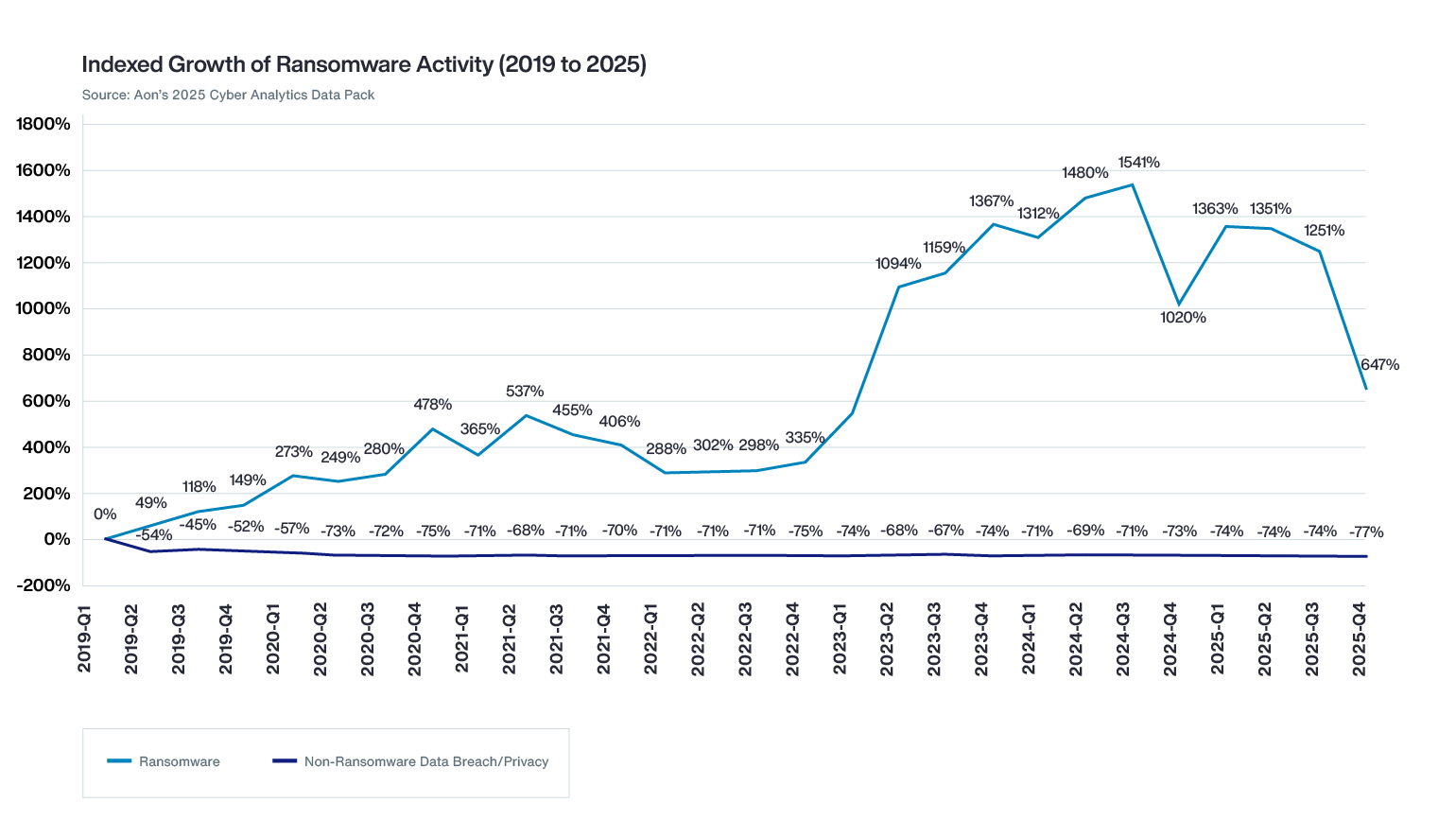
Ransomware Growth is Increasing Cyber Risk for Construction

Ransomware activity has surged by approximately 647% across industries globally over the past five years.

Indexed Growth of Ransomware Activity (2019 to 2025)

Source: Aon’s 2025 Cyber Analytics Data Pack

Cyber incidents are increasingly disrupting physical operations in construction, where tight timelines and complex delivery dependencies leave little room for error. Even a short disruption can cascade into significant delays, cost overruns and contractual exposure. “Cyber events are no longer isolated technology issues,” says Tariq Taherbhai, Global Chief Commercial Officer, Construction and Infrastructure. “They can disrupt projects, delay delivery and directly impact financial outcomes.” The financial consequences can be material, ranging from contractual exposure tied to missed milestones to broader impacts on shareholder value.

Beyond direct losses, cyber incidents can also damage reputation, erode stakeholder confidence and weaken long-term enterprise value, reinforcing the need for board-level oversight. This growing threat is not matched by financial protection. Despite this rapid increase in cyber incidents, cyber insurance penetration in construction remains below 30% globally, according to Aon data. The result is a structural imbalance: Cyber risk is accelerating, while financial protection remains limited.

This gap reflects a broader shift in how cyber risk is understood. It is evolving from a technical discipline into a core component of enterprise risk management, with leading organizations embedding cyber considerations into executive decision making, capital allocation and risk appetite frameworks.

As a result, cyber risk must be treated as both a delivery and an enterprise risk. Yet, despite being the top-ranked enterprise risk, many organizations still manage it as an IT issue rather than a strategic business priority.

  • Top 3

    Real estate and construction firms are now among the top three sectors targeted by ransomware in late 2025.

    Source: Aon’s 2025 Cyber Analytics Data Pack

  • 62%

    of contractors express serious concern about cyber risk.

    Source: 2024 Travelers Risk Index

  • 50%

    of contractors lack cyber insurance cover.

    Source: 2024 Travelers Risk Index

Why Construction is a High-Value Target

Construction’s operating model creates multiple overlapping points of vulnerability. When viewed through an enterprise risk lens, these exposures extend beyond individual projects to impact organizational resilience, financial performance and strategic outcomes. They interact across systems, suppliers and people, increasing both the likelihood and impact of disruption.

  • Ransomware and Data Extortion

    Time-sensitive projects and complex data environments make construction firms attractive ransomware targets, with impacts ranging from prolonged downtime of around 24 days1 to contractual penalties.

    Beyond disruption, the integrity of design and engineering data is becoming a growing concern. While there are limited confirmed cases to date, the potential manipulation of BIM models or computer aided design files presents a high-impact risk. Compromised design data could lead to rework, structural defects or safety issues, amplifying both financial and operational consequences.

    The loss of critical project data, including drawings, models and other digital assets, can also disrupt construction activities and delay project delivery. If this information cannot be restored or recreated quickly, the resulting downtime may lead to significant financial losses and contractual liabilities. Key delivery impacts can include:

    • Significant delays to project delivery
    • Cost overruns linked to rework and disruption
    • Contractual liabilities tied to missed milestones

    This shifts the nature of cyber risk in construction. What begins as a digital compromise can translate into physical-world consequences, affecting project safety, asset integrity and long-term performance.

  • Third-Party and Supply Chain Risk

    Construction projects rely on extensive ecosystems of vendors, subcontractors and partners. Limited visibility across these networks increases exposure, with many breaches originating through third parties. Aon’s latest global cyber data reflects this challenge. In Q1 2026, third-party risk was the lowest-performing cyber domain, scoring just 2.4 out of 4.

    Weak contractual cyber security requirements often compound the issue, leaving expectations, controls and reporting obligations insufficiently defined across project stakeholders.

    These exposures are also attracting increasing scrutiny from insurers and investors, who assess supply chain dependencies as part of underwriting and due diligence processes.

  • OT and IoT Exposure

    Connected equipment and operational technology are expanding rapidly, often without full segmentation from IT systems. This increases operational disruption risk and potential safety impacts. Aon’s Q1 2026 data shows a 10% year-over-year improvement in OT red flags across clients globally, including stronger segmentation and remote-access controls. It also shows that connected environments remain exposed.

    According to Yue Yang, Executive Director, Cyber Solutions, Europe, the Middle East and Africa, cyber resilience needs to be built into projects from the earliest design stages, not added later.

    “Cyber must be introduced when the OT architecture and system philosophy are first defined and carried through to the specification of components such as BMS and sensors,” she explains. “If it is only considered at the component stage, the fundamental attack surface and trust boundaries are already locked in, making retrofit both costly and less effective.”

  • Identity and Human Risk

    Phishing and credential compromise remain leading attack vectors,2 with the former driving a third of initial attacks. Aon’s Q1 2026 data also highlights persistent control gaps:

    • 54% of organizations reported more than 10 service accounts.
    • 48% reported incomplete enterprise vulnerability scanning.
    • 31% of middle-market and SME organizations lacked 24/7 security monitoring.

    As AI increases the sophistication of impersonation and social engineering, these risks are intensifying.

Relative Exposure Across Key Cyber Risks in Construction

These risks rarely occur in isolation. Their interaction creates systemic exposure across projects, including financial, operational and intellectual property impacts.

Risk Type Likelihood Impact
Ransomware High High
Third-party risk High High
OT/IoT exposure Medium–High High
Identity risk High Medium–High
Commercial data and intellectual property risk High High
Quote icon

Construction projects bring together complex networks of people, systems and partners. That interconnectedness is what makes cyber risk both more likely and more impactful.

Tariq Taherbhai
Global Chief Commercial Officer, Construction and Infrastructure

Closing the Construction Cyber Resilience Gap

Organizations are investing in cyber security, but progress remains uneven. While some controls are improving, they are not keeping pace with the complexity of connected construction environments, including BIM integration, third-party platforms and OT systems.

According to Aon’s Q1 2026 cyber data, critical controls improved by 27% year-on-year for renewal clients, and the overall global risk score improved from 2.79 in 2025 to 2.82 in Q1 2026. At the same time, construction continues to lag other industries in overall cyber maturity, reflecting persistent gaps in resilience capabilities such as monitoring, backup readiness and identity controls.

This reflects a broader decision-making gap, where leadership confidence in cyber preparedness often outpaces actual resilience capabilities, particularly in complex, multi-stakeholder environments such as construction.

“The pace of digital adoption in construction is accelerating faster than cyber maturity,” explains Carl Shanks, Director, Cyber Solutions, Europe, the Middle East and Africa. “However, this maturity gap is not only operational. It is increasingly financial.”

Cyber Exposure is Rising Faster than Financial Protection

  • +40%

    Increase in cyber incidents across industries

    Source: Aon data

  • 2.61

    Construction cyber risk score, below cross-industry average

    Source: Aon’s Q1 2026 Cyber Data Pack

  • <30%

    Cyber insurance penetration in construction, indicating a significant protection gap

    Source: Aon data

The Widening Gap Between Cyber Risk and Financial Protection

With cyber incidents rising sharply and insurance penetration still below 30%, many construction firms lack adequate financial protection against a growing threat landscape. This widening protection gap can affect project delivery, insurability and investment readiness. In some markets, limited claims activity may reflect low insurance uptake rather than lower underlying risk.

At the same time, insurance is becoming a commercial requirement. “Contractors are increasingly asked to demonstrate cyber or technology errors and omissions coverage as part of contractual obligations, but are often unable to do so,” explains Grace Norgaard, Vice President & Team Leader, Cyber Solutions, North America.

This creates a growing divide between firms that are insurable and those that are not. Organizations that cannot evidence coverage or meet underwriting expectations may face challenges in securing work, participating in large projects or meeting stakeholder requirements.

Insurance is therefore evolving from a financial backstop into a strategic enabler of project delivery and competitiveness.

Building Construction Cyber Resilience

Cyber resilience begins at the design stage, where considerations must be embedded into system architecture and contractual frameworks from the outset.

To close these gaps, firms need more than isolated controls. They need an integrated approach that connects risk insight, control improvement, response capability and financial decision making, alongside clear allocation of cyber and data risk within contractual frameworks.

On modern BIM-enabled projects, cyber and data risks are increasingly treated as core contractual exposures, but they require explicit drafting. Standard contract forms, such as the New Engineering Contract, the International Federation of Consulting Engineers suite of contracts and the Joint Contracts Tribunal contracts, may not fully address evolving digital risks.

This is where Aon’s differentiation becomes clear.

Combining CyQu analytics with advisory and insurance capability gives risk managers a quantified view of exposure and clearer pathways to improve controls, strengthen insurability and support investment decisions.

“What differentiates leading organizations is visibility,” Yang notes. “Data-led insight allows firms to prioritize investments, quantify risk and align cyber resilience with business outcomes.”

3 Strategic Priorities for Construction Cyber Resilience

  • 01

    Secure Connected Environments

    The convergence of IT, OT and third-party systems requires a stronger security foundation. Applying Zero Trust across BIM and project systems, strengthening identity controls, and improving segmentation and visibility help reduce systemic risk in connected construction environments.

  • 02

    Improve Response and Recovery Capability

    Even with stronger controls, incidents remain inevitable. Resilience depends on how quickly organizations detect, respond and recover. Priorities include AI-driven detection, scenario testing and resilient backups, including immutable, offline and offsite recovery.

  • 03

    Align Cyber Resilience with Financial Outcomes

    Cyber resilience must drive business outcomes, including insurability, coverage quality and pricing. Organizations that demonstrate stronger controls and clearer risk visibility are better positioned to secure appropriate coverage, optimize limits and avoid restrictive exclusions.

Cyber risk now sits alongside safety and delivery as a core construction risk, with implications for how projects are financed, insured and delivered. Firms that can demonstrate resilience, insurability and robust control environments will be better positioned to secure capital, meet stakeholder expectations and deliver complex projects with confidence. Closing the gap between cyber exposure and financial protection will be central to achieving this.

Quote icon

Digital innovation is reshaping construction. An equally innovative approach to cyber resilience will ensure these gains are built on a secure foundation, protecting projects, profits and reputations in a world of rising cyber peril.

Yue Yang
Executive Director, Cyber Solutions, Europe, the Middle East and Africa

Connect with Aon’s Cyber Solutions team to assess your organization’s construction cyber maturity and build a tailored resilience roadmap.

Aon’s Thought Leaders

Yue Yang
Executive Director, Cyber Solutions, Europe, the Middle East and Africa

With contributions from Nathan Jones, Grace Norgaard, Carl Shanks and Tariq Taherbhai.

General Disclaimer

This document is not intended to address any specific situation or to provide legal, regulatory, financial, or other advice. While care has been taken in the production of this document, Aon does not warrant, represent or guarantee the accuracy, adequacy, completeness or fitness for any purpose of the document or any part of it and can accept no liability for any loss incurred in any way by any person who may rely on it. Any recipient shall be responsible for the use to which it puts this document. This document has been compiled using information available to us up to its date of publication and is subject to any qualifications made in the document.

Terms of Use

The contents herein may not be reproduced, reused, reprinted or redistributed without the expressed written consent of Aon, unless otherwise authorized by Aon. To use information contained herein, please write to our team.

More Like This

View All
Subscribe CTA Banner